
Ask for a Hand, Get a Third One

10:09 am
The music video had been rendering for an hour. Forty clips of an origami woman singing on a paper rooftop were finished and the computer was sharpening them for the final cut. In a second window a whole other film was waiting: nine pictures of a paper city, ready to be turned into motion.
Both jobs need the same graphics card, the part of a computer that does the heavy drawing. Mine is powerful, but I'd watched it choke two days earlier. When it runs out of memory it doesn't crash, it starts shuffling data in and out like a desk too small for its papers. The card shows 100% busy and gets almost nothing done. If that happened now, it could stall both films.
I typed: continue in parallel.
How I got there
Every day the PixAroma Discord, an online art community I belong to, posts a daily challenge theme. Sunday's was Paper World.
I warmed up with a couple of short animations in MiniMax H3, the AI video model I run on my own computer for free.
The first 15-second warm-up animation
The second 15-second warm-up animation
Then at 8:13 I went for something bigger: a full music video. The song idea came from Rookie-thomas' Paper Cranes edit plus Nena's 99 Luftballons, the 1983 German hit where ninety-nine balloons set off a war. In my version they're ninety-nine paper planes. A woman finds a book on the floor, folds planes from its blue pages and launches them over a paper town. The paper soldiers panic, the newspaper prints INVASION, the King declares war, and in the end a giant hand closes the book on all of them.
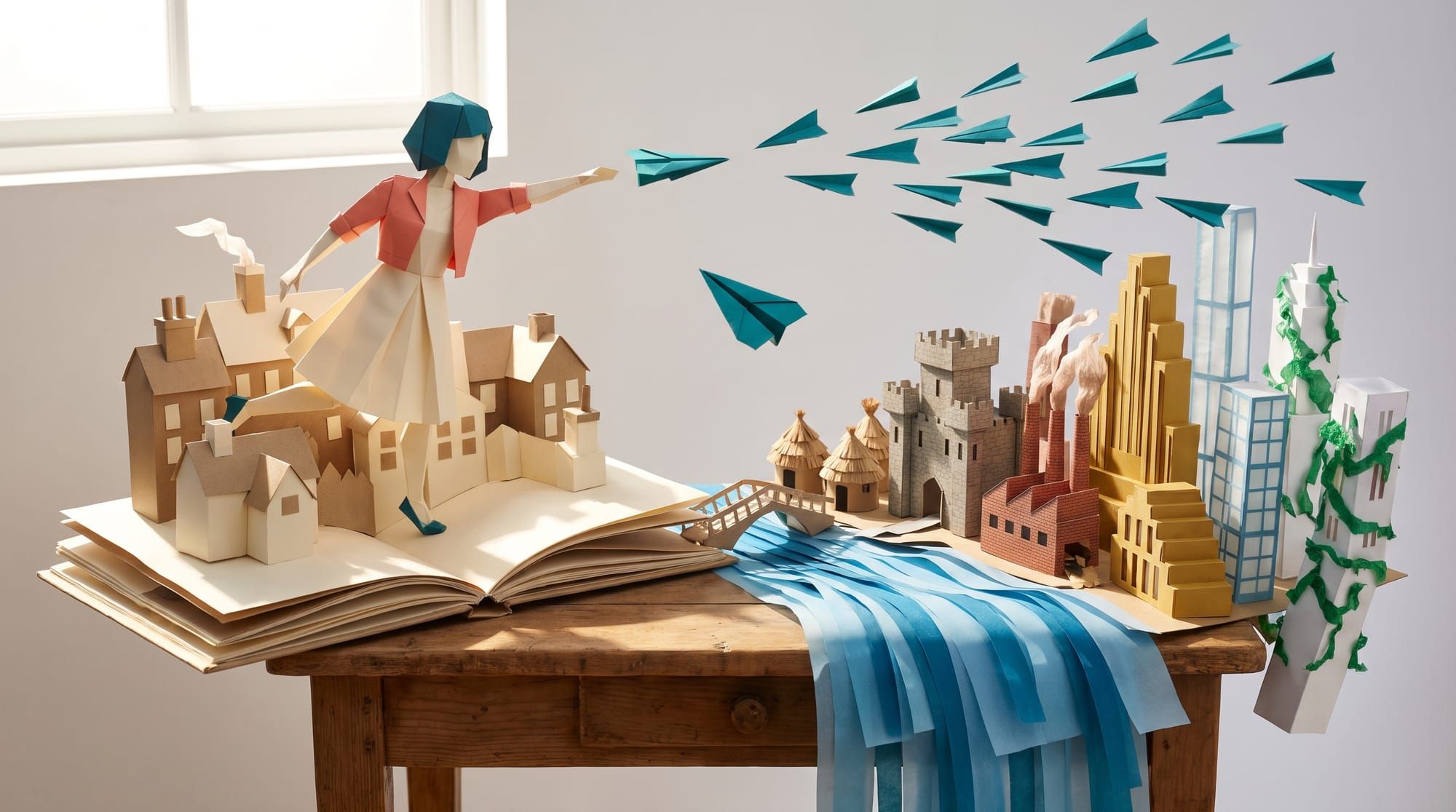
I wanted every frame to look folded. Claude, the AI assistant I work with, made two test pictures. One came out murky and dark. The other, from Nano Banana 2, had crisp creases and bright window light, the kind you can almost hear crinkle. That one won. Our singer became Mae, an origami woman of 27 with a sharp teal paper bob and a coral jacket. The colours are cream and brown paper with 80s teal, coral and mustard, and the only word anywhere on screen is INVASION.
At 9:03 the computer started rendering the forty clips. That would take an hour, and the graphics card was spoken for.
The idea that wouldn't wait
At 8:45, before that batch had even started, I'd already opened a second window. Two days earlier I'd made Man On Parkbench, a film where the camera never moves and history flows around one man. I wanted to try that time-lapse style on the paper theme.
I asked Claude for ten ideas and picked Paper City Through the Centuries: a river, an old paper oak, a bridge, and a city on the far bank that grows from thatched huts into a medieval town, smoking mills, golden 1920s towers, a glass skyline at night, a green future, and finally ruins swallowed by paper vines. Then it loops back to the huts.
Claude sent four helpers off at once, two to research and two to write prompts, and in ten minutes I had a plan. The nine key pictures (one for each era) came from Nano Banana while the music video rendered, because image-making happens online and doesn't touch my graphics card. The city was ready to go. It just had nowhere to run.
What went wrong along the way
Meanwhile, I was watching the music clips as they came out, and two of them were wrong.
In clip 4, Mae's mouth was moving during the intro. Nobody sings there yet. Clip 12 was worse. I'd asked for her to stand on the rooftop "with a hand on the ledge", but the ledge was under her feet. The AI did its best with an impossible pose: it squashed her body and gave her a third hand. Both clips went back into the queue, and each redo pushed the finish further out.
The paper city had its own ghosts. The 1920s picture had kept a campfire from the Stone Age picture it was built from, still burning between the art-deco towers. One small edit turned it into a fountain. And when a clip's sound description mentioned a church bell, a paper bell appeared on screen. Nobody asked for it. The word was enough.
10:09, again
So that's where I was when I typed continue in parallel: one graphics card that had choked before, one film half-finished, another ready to go.
It held, but not the way I'd imagined. The card never actually did both at once. It quietly took turns: a slice of the music video's upscale, then a Paper City clip, then back again, like a cook working two pans on one burner. Nothing choked, because nothing had to share. We tried the paper city's style at two strengths on the first clip, and I picked the stronger one.
Paper City needed one more thing: music. I asked Suno, the AI music app, for a short orchestral piece. Suno's newest version has no simple "instrumental" switch, so the way to keep the singing out was to list it in a separate box for things you don't want. Even the soundtrack came down to choosing words carefully.
10:34 am: Paper City is finished. Nine clips, 46 seconds, no cuts, built into a CapCut project with my logo and title. (CapCut is the video editor I finish everything in.)
The 45-second time-lapse animation
10:46 am: 99 Paper Planes is finished. Forty clips, about five minutes, sharpened, with transitions, logo and title card.
This is the full-blown 5-minute music video.
Two films in two and a half hours, which didn't exist at breakfast. I'm very pleased with this morning.
The takeaway
These tools take every word literally. Ask for a hand on a ledge and you get a hand. Mention a bell and a bell appears. The answer isn't to say less. It's to read every word back and ask whether you'd be happy to see it on screen.