
Creating Art by Hand

The short version (TL;DR): AI can now make in 1 or 2 minutes what usually takes an artist hours to execute after many years of practice. For most of us drawing was never about speed, so that race doesn't matter.
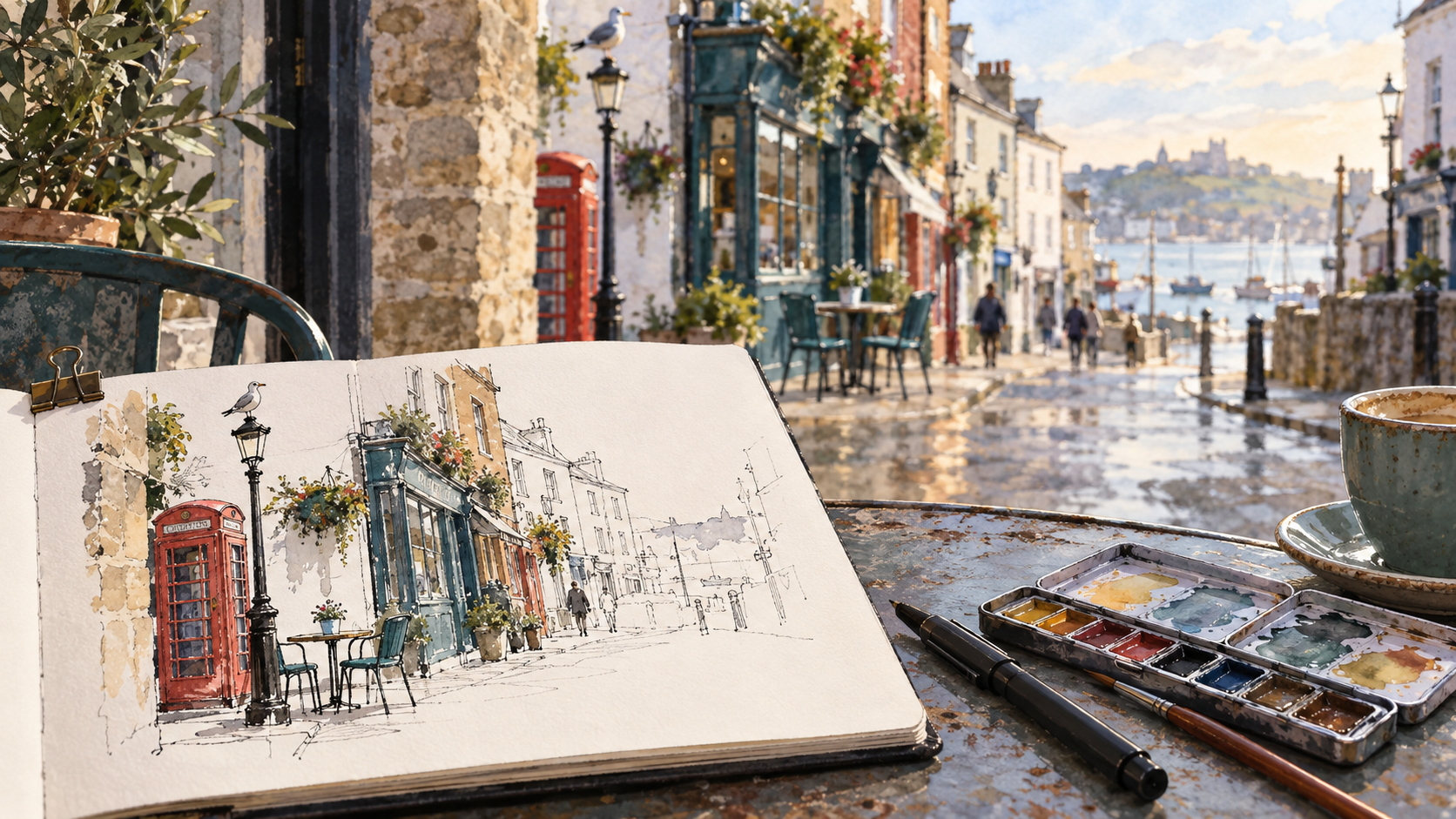
My daughter is a skilled self-taught artist. I recall her doing an urban sketch with watercolors at a park in Manhattan when I had visited her once.
This week I watched a short vlog by an animator who goes by Trev El. Viz. He draws animation frame by frame, and a few seconds can take him days. AI can now produce something similar in minutes.
So he wonders whether he's "preserving a craft or just becoming inefficient."
I don't dismiss the question.
I use AI tools heavily in my own creative work, including ALL my music videos.
But one of his chapter titles stuck with me: When a Craft Becomes a Luxury.
Here's my conclusion and current thinking. For most of us, drawing was never about efficiency. It's about paying attention, slowing down, and making something with our own two hands. And if handmade art is becoming a luxury, it's the cheapest one going.
In college, we had history of architecture as a subject one semester, and my sketchbook (where I got the highest grade in my class) is one of my favorite memories of my 5 years of architecture school...
I plan to take up and resume hand drawing and painting, at the local Thursday art meetup at the historical society of Davenport.
1. What to buy (less than you think)
A practical beginner list is a Substack post, Grabbing Art Supplies from Amazon that Bryan Sykes created at my request.
He says anyone can and should do art, starting with five minutes a day and building up from there. The shortlist:
- Pencil: a Ticonderoga No. 2 (HB), for sketching you can erase
- Pens: a Zebra F-301 ballpoint for quick lines, and Sakura Pigma Micron fineliners in a few weights for detail
- Paint: a MozArt 24-color watercolor set with a metal mixing palette, and a Pentel brush set for travel
- Paper: proper watercolor paper from Canson, Arches, Strathmore or Saunders Waterford
- Everything else: a Moleskine notebook and a roll of paper towels
None of it is specialty equipment, and it all fits in a small bag.
I ordered about $90 in art supplies from Amazon, most of it will be delivered today, Sat Sep 12th.
2. The first lesson: loose ink and watercolor
Jillee Arts has a 35-minute tutorial, Loose ink and watercolor sketching for beginners, filmed in real time. That's the best part: you draw at her pace, not a sped-up one.
- Start from a reference. She works from a picture, not from memory.
- The pen does most of the work. Outlines take about 18 of the 35 minutes.
- Color comes second. Watercolor goes on over the ink, then the shadows, then the finishing touches.
- Any good pen will do. She uses a Lamy Safari fountain pen, but a Micron from the list above works just as well.
What I like most is why she sketches. When she feels stressed or stuck, she starts with something small and simple, and that small action builds momentum for the harder work. A small start beats a big plan you never begin.
3. Going outside: urban sketching
Urban sketching means drawing the world around you, on location, as it is. That can feel intimidating. Sketching Scottie's 20-minute How To Sketch ANYTHING!4 makes it manageable by breaking a scene into single objects:
- Six objects, one at a time: a plate of food, a telephone box, a window, flowers, a seagull, and a café table with chairs
- Watercolor last, once the drawing is done
Learn six objects, and a whole street scene turns out to be those objects standing next to each other.
4. Five lessons to save you some frustration
Once you're painting, set aside 17 minutes for Kristin Van Leuven's 5 things I wish I knew before I started watercolor. These are the basics that decide whether watercolor turns out magical or muddy.
- Lighten with water, not white. Darken with less water, not black. Watercolor is transparent. White makes it chalky, and black dulls the color itself. For a dark, take the paint almost straight from the pan.
- Water control is the real skill. She thinks of consistency as a scale: tea, coffee, milk, cream and butter, from mostly water to almost pure paint. Start light, because once a light area is covered you can't get it back. When unsure, test the mix on a scrap of paper first.
- Paper matters more than paint or brushes. She wasted time on cheap cellulose paper before switching to Arches 140 lb cold-press cotton. Her tip for the cost: cut one pad into smaller pieces.
- Every painting has an ugly stage. The first light washes look flat and boring. That's normal. Keep layering.
- Learn a little color theory. For shadows, mix in the color's complement instead of black. A touch of orange darkens a blueberry's blue far more naturally than black does.
Paper is the one place where this post's cheap-supplies advice bends. Good paper is worth paying for, which is why Arches is on the list in section 1 too.
Why this matters now
I don't think AI will stop dedicated people from drawing, any more than photography stopped people from painting. It may even help. The less drawing is needed for work, the more it becomes something we do because we enjoy it.
If you want some structure, try Danny Gregory's 7-day illustrated journaling challenge from Sketchbook Skool. He picked up the habit in his late thirties, when he hadn't drawn since he was a little kid. Today he has a shelf holding hundreds of illustrated journals.
An illustrated journal is a diary with simple drawings: sketch a moment, write a few lines about it, turn the page. The challenge takes 10 to 15 minutes a day, any pen (he started with a ballpoint) and any cheap notebook. The whole thing is in the free video; his paid courses are optional. There's one prompt a day:
- Day 1: your breakfast
- Day 2: your outfit
- Day 3: a book you're reading or music you love
- Day 4: your pet (a plant counts)
- Day 5: a place you went today
- Day 6: a quiet moment you carved out for yourself
- Day 7: anything at all, drawn in bed at the end of the day
His one rule is not to overthink it. It's about the process, not about making great art.
At work we're paid to be efficient. A sketchbook is the one place nobody is timing you.
Sources
- Trev El. Viz, AI Is Making Me Stop Animating (September 7, 2026)
- Brian W. Sykes, Grabbing Art Supplies from Amazon (September 8, 2026)
- Jillee Arts, Loose ink and watercolor sketching for beginners | Real-time tutorial (November 5, 2023)
- Sketching Scottie, How To Sketch ANYTHING! | Urban Sketching Objects For Beginners (November 15, 2024)
- Kristin Van Leuven, 5 things I wish I knew before I started watercolor (January 4, 2025)
- Danny Gregory for Sketchbook Skool, The 7-Day Art Challenge That Changed My Life (You Can Do It Too!) (September 19, 2024)