
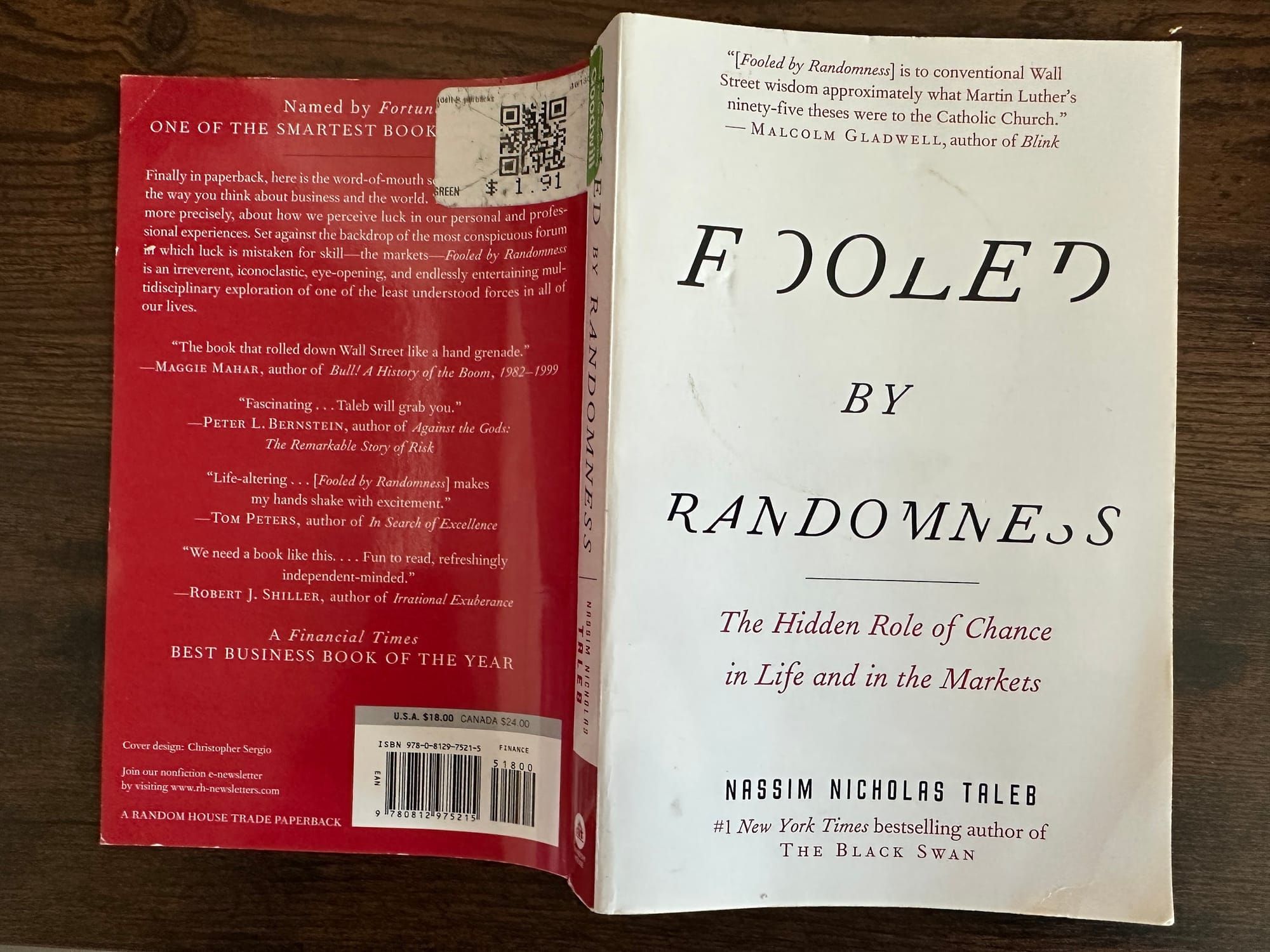
Fooled by Randomness
TLDR - Watch the brief video...

The Lucky Tie, the 70/30 Bet and the Question I Now Ask
Nassim Nicholas Taleb spent about two decades as an options trader before he wrote Fooled by Randomness in 2001. It's a short, opinionated book with one big claim: we are terrible at telling luck from skill, and we pay for it.
My new 4 minute video covers the book's most famous examples.
Below are few stories from the book that didn't make the video, and the lesson I took away.
The lucky tie. Taleb admits he isn't immune. One morning his taxi dropped him at the "wrong" entrance to his bank's building, and he had a very good day of trading. The next morning he asked to be dropped at the same entrance, and he wore the same tie. A man who made his living from probability caught himself running a superstition. Our brains are built to see cause and effect, even in noise, and knowing that doesn't switch it off.
Carlos, the bond wizard. Carlos traded the debt of developing countries, Russia among them. For years he made steady money by buying whenever prices dipped, because they always bounced back. In the summer of 1998, Russia defaulted. The dip kept going, Carlos kept buying, and years of good results were wiped out in a few weeks. His method had never been tested by the one event that mattered.
The Nobel prize winners. That same year, Long-Term Capital Management, a hedge fund whose partners included the Nobel prize-winning economists Robert Merton and Myron Scholes, nearly collapsed. Its managers described the loss as a "ten sigma" event, something their models said should almost never happen. Taleb's point: when your model says something is all but impossible and it happens anyway, the problem is the model, not the world.
The 70/30 bet. At a meeting, Taleb was asked where he thought the market was heading. He said it was 70% likely to rise over the coming week, yet he was betting that it would fall. That sounds like a contradiction until you look at the size of the moves: a 70% chance of rising 1% against a 30% chance of falling 10%. Being right most of the time can still lose you money.
My takeaway
Stop asking "How likely am I to be right?" and start asking "What happens if I'm wrong?" Probability tells you how often; the payoff tells you how much. Many money disasters, personal or professional, come from strategies that win small and often while hiding one large loss.
Before I make a decision now, I try to name my "30%": the unlikely outcome, how big it would be, and whether I could live through it. If I couldn't, the odds don't matter.
The book also changed how I judge other people's success. A big win might be skill, or it might be a lucky tie. The honest test is how someone got there and what they risked along the way.
Last year I wrote about a related shift in my own thinking, from trusting statistical forecasts to doubting them, in Predictions: From Minitab to Mindset Shift. If this book speaks to you, that post is also worth a read.