
How to build a well-designed life?
A well-lived life isn't something you find; it's something you build, test, and refine, one small, joyful experiment at a time

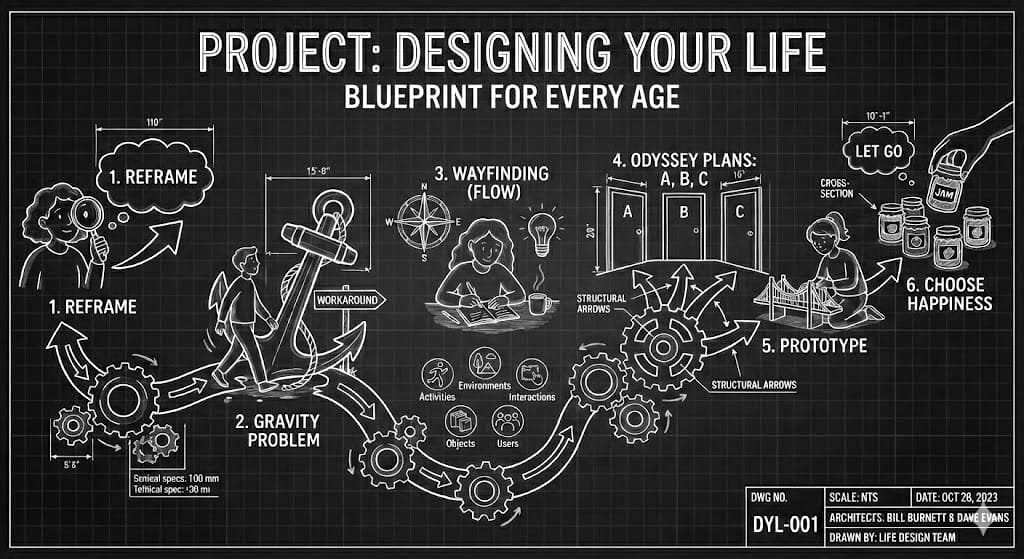
Designing your life was a book by Bill Burnett and Dave Evans that I borrowed from the library recently. I liked it and bought a copy for my daughter as well.
It’s Never Too Late to Build a Life You Love
Whether you are 30 and wondering if you picked the wrong career, or 70 and wondering what your "encore" looks like, the feeling of being stuck is universal.
We’re often sold a bill of goods: that our college degree at 22 determines our destiny, or that "retirement" is a finish line where the designing stops. Life is not a destination—it’s a design project. You don't need a map; you need a compass. Here is how to apply the principles of Stanford’s most popular class to your life, no matter what decade you're in.
1. The Power of the Reframe
Designers don't start with the problem; they start with empathy. For yourself.
- The Dysfunctional Belief: "I should already know where I'm going."
- The Reframe: "I am never stuck because I can always generate new ideas."
At 30, you might be reframing your career path. At 60, you might be reframing "aging" from a decline into a source of wisdom and mentorship.
Remember: Three-quarters of college grads don't work in their major's field.
Who you are growing into is more important than what you used to be.
2. Don’t Fight "Gravity Problems"
In design, if a problem isn't actionable, it’s not a problem—it’s a circumstance.
"You can’t change gravity. If you’ve been unemployed a long time, or if the industry has moved on, that is a fact of life. Acceptance is where all good design begins."
When you stop banging your head against a "Gravity Problem," you free up energy to find a workaround. You can't change your age, but you can change the industry you target or the way you leverage your experience.
3. Wayfinding: Follow the Energy
How do you find your way when you don't have a map? You look for Flow—that state where time stands still and you’re fully engaged.
To find your "North Star," keep a Good Time Journal for three weeks. Note when you feel energized and when you feel drained using the AEIOU method:
- Activities: What were you doing?
- Environments: Where were you?
- Interactions: Who was there?
- Objects: What tools were you using?
- Users: Who were you doing it for?
Work is fun when you lean into your strengths. This applies to a high-powered law firm or a local community garden.
4. Build Three "Odyssey Plans"
Most of us get stuck because we fall in love with our first idea. Designers know that you choose better when you have options. Try creating three alternative versions of your next five years:
- Plan A: The path you’re currently on.
- Plan B: What you’d do if Plan A suddenly wasn’t an option.
- Plan C: The "Wildcard"—the life you’d lead if money and reputation didn't matter.
5. Prototype Your Way Forward
You wouldn't buy a car without a test drive. Why commit to a new life path without a "prototype"?
- Prototype Conversations: Talk to someone doing what you’re curious about. Ask, "What is it really like?"
- Prototype Experiences: Spend a day shadowing, volunteering, or taking a class.
Remember: 80% of the best opportunities are never posted online. They are found through these "directions-asking" conversations.
6. The Secret to Choosing Happiness
We often think more choice makes us happier. But Sheena Iyengar's "Jam Study" proves the opposite. When shoppers were offered 24 jams, they were paralyzed. When offered 6, they bought and were satisfied.
How to apply this?
| Step | Action |
| 1. Gather | Create your options through ideation. |
| 2. Narrow | Cut the list down to your top alternatives. |
| 3. Choose | Pick the one that resonates most. |
| 4. Let Go | Embrace your choice fully and don't look back. |
To sum up, the book was a vivid reminder that a well-lived life isn't something you find; it's something you build, test, and refine, one small, joyful experiment at a time.