
Tenacity Makes Twenty. Curation Keeps One.


Someone from India messaged me on Discord this week. He wanted career advice on how to get a job (making images and videos).
It's a fair question to ask on a server full of people making images and videos. It's also a question I couldn't answer right away, which bothered me enough to think more about it.
The obvious answer is worthless. Learn the tools. He already has the tools. So does everyone. That's the whole problem - the thing that used to be the qualification is now the price of entry, and the price of entry is zero. I could have told him to build a reel and I'd have been telling him to join a queue thousand deep, every person in it holding roughly similar images or videos.
So instead of answering, I went back through my own conversations with the people whose work actually stops me. Three of them. And they all told me the same thing without any of them meaning to.
1. Nigel, and the thirty-one I never saw
In mid-July I shared that a Discord user named NineLayerNige had made an animation of me. I loved it enough to use it for the opening screen of my app Sebland.
I asked him how he did it. His answer started where I expected - with the gear:
"yes, all my current stuff is LTX2.3 and I can easily do 30 seconds on my 5090 at 720 x 720 in about 5, 6, 7 mins. I also upscale using SEEDVR2, but thats very slow and only upscale as a separate wf if needed."
Then it stopped being about the gear:
"It may have taken me several seeds and various prompt tweaks to get the final acceptable output, its never a one shot result, its grinding away always. Maybe Sebland took 20 image seeds and 12 LTX 2.3 image to vid seeds and prompt tweaks."
Twenty variations to choose one image. Then a dozen animations to choose the best !!
I had been looking at the survivor.
2. Hammel, and what the prompt doesn't tell you
My friend and Discord moderator Hammel answered an image I'd posted for the daily challenge with a video clip good enough to make me laugh out loud: Leslie Nielsen...
I asked him the same question. How?
He sent me the prompt.
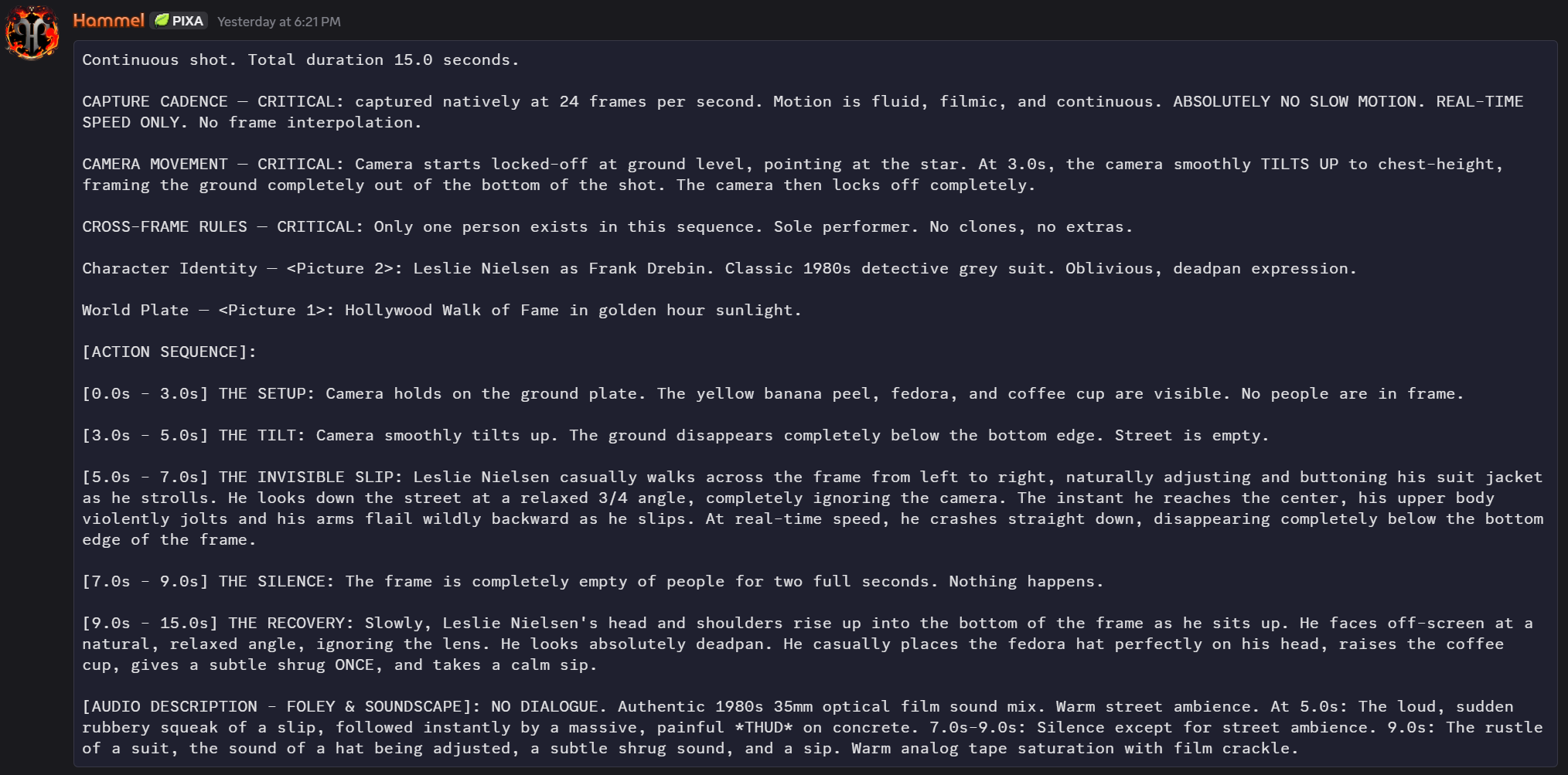
I told him why I loved it. The hat and coffee with the nonchalant shrug are hilarious, sure - but the real cleverness is that you never see him slip. He drops below the bottom edge and your own brain supplies the pratfall.
This is where I got the answer I wasn't expecting. Because the prompt was not the secret. Here's the secret:
"hm, that i need to 'not show' the peel when slipping was clear after one or two attempts, but I was not satisfied with the slip over and over again.. and you know me, its hard for me to show something that I am not super satisfied with but I had to finish it because of family coming back, so I had to take my best shot so far.. otherwise I would have spent another 2 hours to check if the composition in general is okay, I do very low res videos, like 0.2 or 0.3 megapixels"
Read that again. The idea I praised - hide the peel - arrived almost immediately, inside one or two attempts. Everything after that was rejection. Over and over again. He shipped it even though he was still, on the record, not satisfied.
He also works at 0.2 or 0.3 megapixels. He deliberately generates cheap, fast drafts, because at that resolution he can't be seduced by the polish. He can only see whether the thing works.
Anyone can copy that prompt.
Not everyone can copy the twenty times he looked at a competent slip and said no.
3. Ioan, and the confession
The third came from a year earlier. Ioan aka Pixaroma has north of 115,000 subscribers on YouTube. When he helped me with my first music video, he said something I read at the time as modesty and now read as a job description:
"But it is up to you, it depends how professional you want that to look, and you don't have to take my advice you know i am too perfectionist"
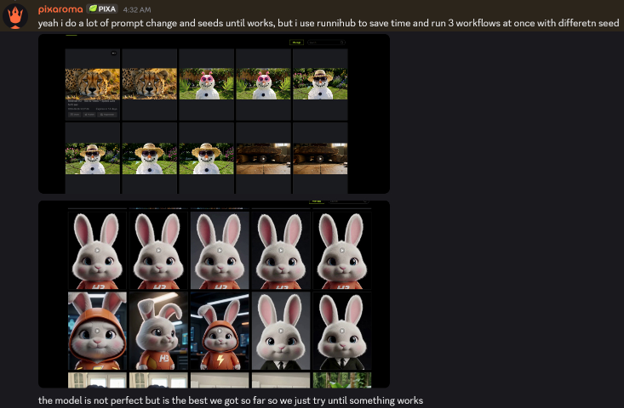
Three people, three tool stacks, one shared habit. None of them ever show the hard work. They show the tip of the iceberg, what survived it.
The part that makes the question hard
Here's why I stalled on that Discord message, and I don't think there's a graceful way around it.
Everything Nigel, Hammel and Ioan do has just become nearly free. Anyone with a phone and a chatGPT can produce twenty variations of almost anything before their coffee cools. The grinding - the tenacity - used to be the moat, and the moat is filling in fast. That's what people are pointing at when they say "AI slop." It isn't that the outputs are bad. It's that the outputs are fine, but there are thousands of them, and nobody threw any of them away.
So when someone asks how to get hired doing this, the honest starting point is that the skill he thinks he's selling may be the one thing nobody needs to buy anymore.
Which leaves the actual question: if generating twenty is free, what's left?
The scarce skill is discrimination
What's left is knowing which one is the keeper - and being willing to bin the other nineteen after they cost you almost nothing to make.
That last clause is the hard part. When a variation costs six minutes on an RTX 5090, deleting it feels like nothing. When it costs almost nothing, deleting it feels like waste - the temptation is to keep it, post it, ship it, and let the feed do the sorting.
Hammel's instinct, "its hard for me to show something that I am not super satisfied with," is the entire discipline compressed into one sentence.
None of this is new, incidentally.
Photographers call it hit rate, or keeper rate, and work off a contact sheet. Printmakers pull state proofs. Directors shoot takes. Writers cut drafts. Every one of those names the same arrangement: volume is simply the price of one good result. AI didn't invent the arrangement. It made the volume cheap and left the bill for the judgment unpaid.
Principle of Scarcity
There's a talk by Mike Gibbs on Robert Cialdini's Principle of Scarcity, aimed at technology professionals - the argument being that you build credibility by specializing deeply, leveraging the background nobody else has, and being consistently trustworthy, so you stop being what he calls a "generic commodity."
Watching it after these three conversations, the point landed somewhere he probably didn't intend. Scarcity hasn't disappeared in the age of generative tools. It relocated. It used to live in the making - in whoever could run the render, drive the software, afford the camera.
Now it lives in the taste: in the person who can look at thirty-two plausible outputs and say, with reasons, that thirty-one of them are wrong.
So here's my answer
Don't build a reel. Build a keeper rate - and then make it visible.
Show the contact sheet. Put up the twenty and circle the one, and write the sentence explaining why the other nineteen died. This one's composition breaks at the third second. This one's hands are fine but the light contradicts the window. This one is technically perfect and says nothing. That explanation is the product. It is the one part of the process that can't be regenerated by the next person with the same checkpoint and a faster card.
It's also the part that travels. A reel from India competes with thousand reels from everywhere, all rendered on the same models, all roughly equal.
Demonstrated judgment doesn't compete with anything, because almost nobody is showing it - it's slower to build, it's unglamorous, and it requires admitting in public that most of your output isn't good. Which is precisely why it's scarce, and precisely why it's hireable. Nobody is short of people who can generate. Everyone is short of someone they can trust to choose.
And I don't have to argue this in the abstract, because someone is already doing it - in India, no less. Keshav Grover is a brand identity and logo designer in Chandigarh. What fills his LinkedIn feed isn't a gallery of finished marks. It's animations that walk you through the thinking - how the shape got to be that shape, what the earlier versions were, why they lost. The logo is the artifact. The reasoning is the post.
The result is a designer who is, by all appearances, extremely busy - not because he produces more logos than anyone else, but because thousands of people have now watched him decide. Reputation followed the reasoning, work followed the reputation.
He also seems to have taken his time about it: he's written about posting steadily for three years to a couple of thousand followers before a single week broke it wide open. That's the same shape as everything else in this post. Twenty seeds, twelve animations, three years of posts. The volume is the price of the one that lands.
The AI tools reached the man who messaged me at the same moment they reached everyone else. That's the bad news and it's also the entire opportunity: geography stopped mattering roughly five minutes ago, and taste never did depend on it. Grover is the proof - same country, same internet, no permission required.
Tenacity makes twenty. That part is table stakes now, and getting cheaper by the month.
Curation keeps one. That's the part still worth being known for — and, if he'll take a stranger's advice, the part worth becoming known for.
With thanks to NineLayerNige, Hammel, and Pixaroma, each of whom shared about their outtakes.