
The Man Who Was Never Asked

On Open: An Autobiography by Andre Agassi, with J.R. Moehringer (2009)
I'd never have picked this up book on my own. I heard Sam talking about the book on the My First Million podcast and ordered it from the library that evening, which is very nearly the only way someone like me arrives at this book.
Twenty bobby pins
The night before the biggest match of his life, Andre Agassi's hair fell apart in the shower.
He was twenty, about to play his first Grand Slam final, and he'd been wearing a hairpiece since his hair started going at seventeen. The weave came undone in his hands. His brother went out into the Paris night and came back with twenty bobby pins, and Agassi walked onto the clay at Roland Garros in 1990 pinned together, playing Andrés Gómez for a major title while praying — this is the actual content of his mind during a Grand Slam final — that his hair would stay on. He lost in four sets.
The line everybody stops at
Here's the sentence everybody knows:
"I play tennis for a living, even though I hate tennis, hate it with a dark and secret passion, and always have."
It's the thumbnail on every book-summary video, the thing people quote at you the moment they find out you're reading it. The lesson usually extracted: you can be world-class at something you hate.
That's backwards — and the giveaway is that it isn't the first line. The book actually opens: I open my eyes and don't know where I am or who I am.
That's the real subject. Everyone quotes the other one. He spends the rest of the book dismantling it. He doesn't hate tennis; he hates what tennis was being used to do to him, and it takes four hundred pages to separate the two.
A man who believed in math
His father worked it out on paper. Twenty-five hundred balls a day is seventeen and a half thousand a week is very nearly a million a year, and then the coldest line in the book: He believes in math. Numbers, he says, don't lie. A child who hits one million balls each year will be unbeatable.
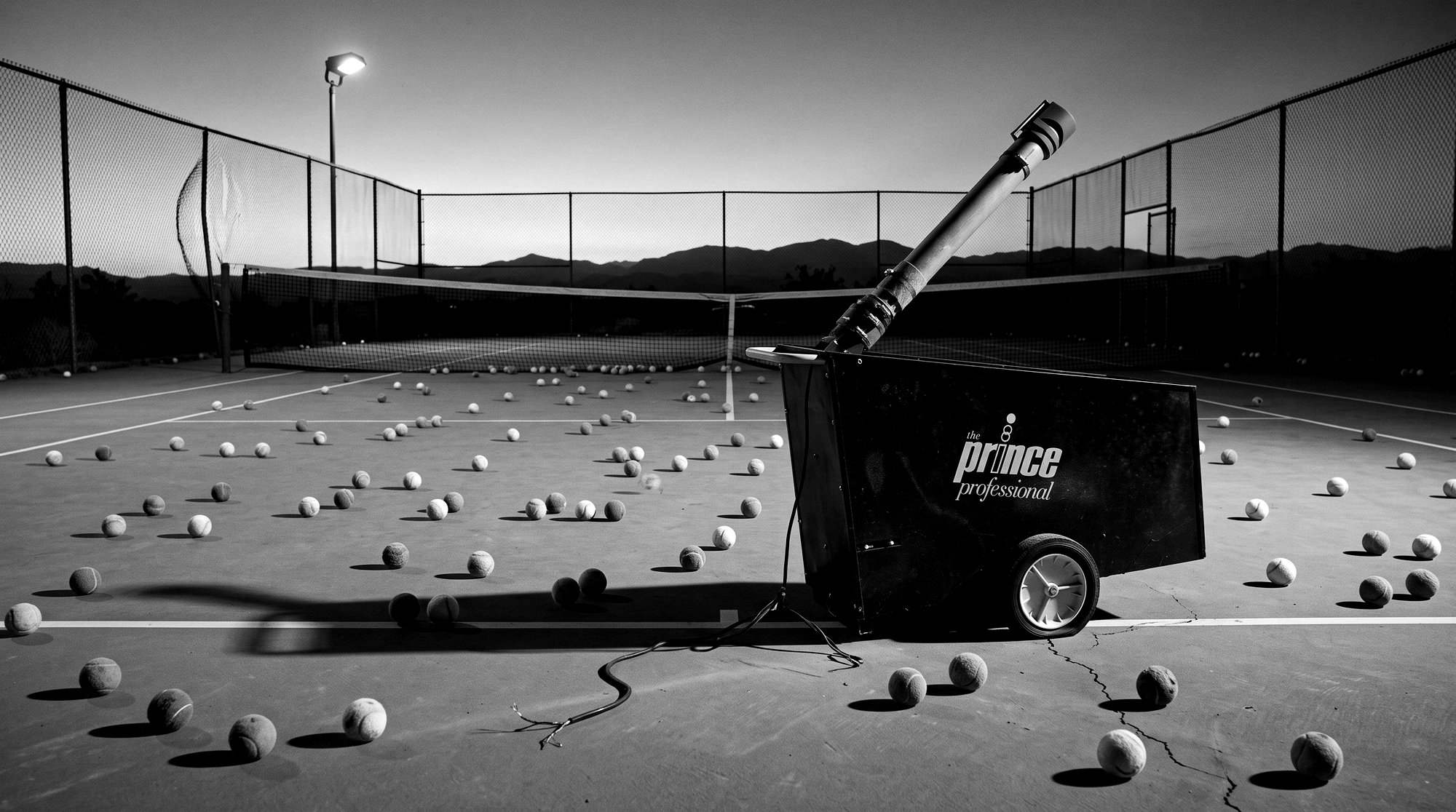
There was a ball machine in the yard. Agassi called it the dragon. He was seven.
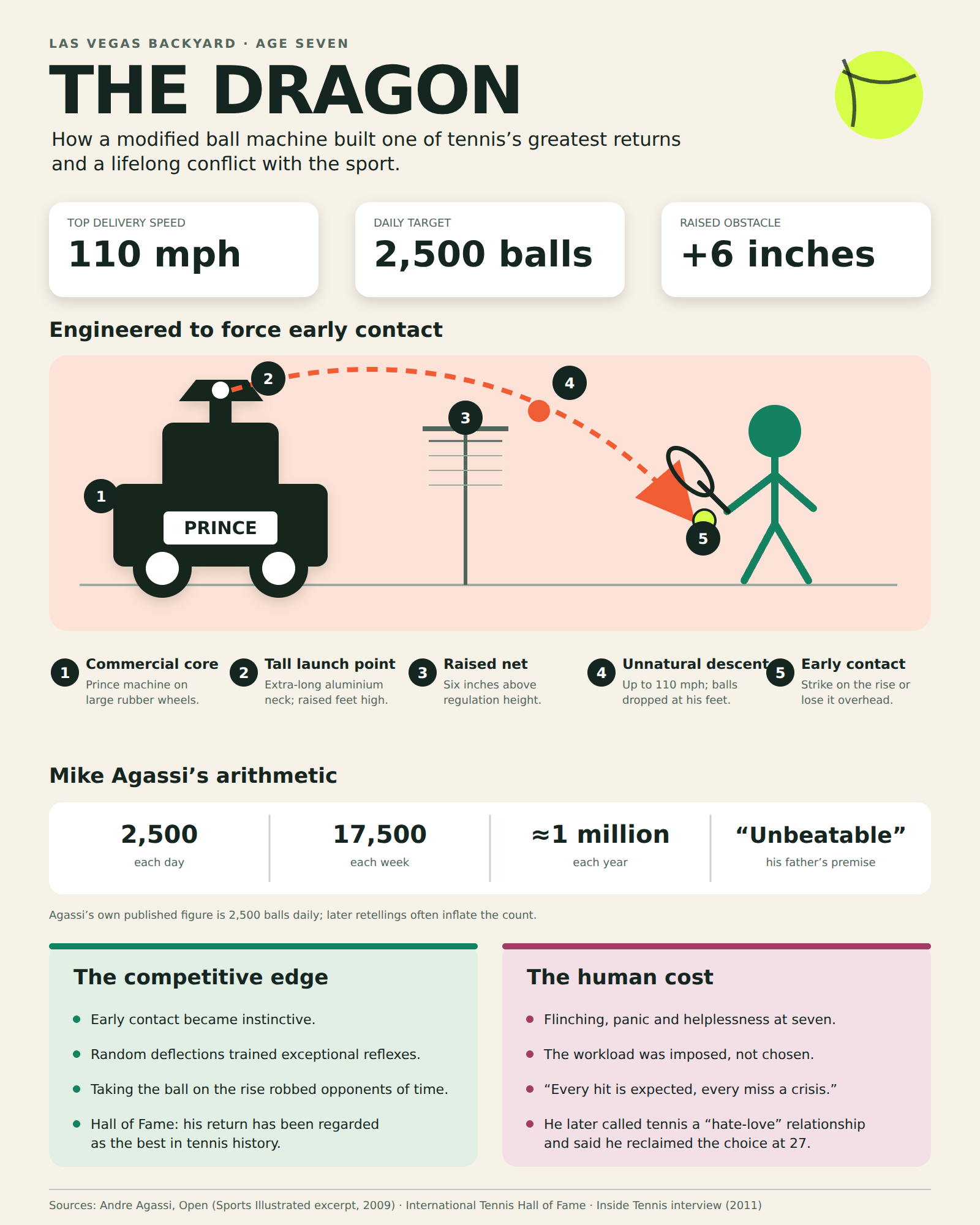
That's the thing he hates — not the sport, but the dragon and the arithmetic and the fact that nobody ever asked. He was shipped to Bollettieri's academy at thirteen and never finished school. By the time anyone thought to ask, he was the best on earth and far too late for the answer to be any use.
And here's the tell: he starts to enjoy it at the end. The 1999 French Open that completed the career slam, the climb back to number one the day before his thirty-third birthday, the last match in 2006. Same sport, worse body. What had changed was that by then he was playing for a school he'd built, for Gil Reyes, for Stefanie. You cannot hate a thing you chose the way you hate a thing you were handed.
The gist, and where it goes wrong
Meet this book secondhand — a summary, a podcast, a list of lessons — and the gist is roughly: practice makes perfect, and helicopter parenting pays off. A million balls a year produced eight majors. The math worked. The old man was right.
That isn't invented. It's how the book travels. The 2,500-balls figure survives every retelling in every language, and there's a well-known podcast episode on Agassi titled, entirely without irony, Tortured Into Greatness.
But it takes the trophies as the verdict. You don't get to cite the eight majors as proof the method worked and then decline to look at the man who couldn't get out of bed. Both are in the same book, out of the same arithmetic, and they don't come apart. The dragon made a champion and a wreck in one motion. If you're minded to run that experiment on a child, that's the full result — not the half you'd prefer.
The part I wasn't ready for
I'm 2 weeks from retiring, after thirty-odd years of practice, and I picked this up expecting a sports book.
It isn't one. It's about a man who did a single thing so completely he had no idea what was underneath it, and then had to find out at thirty-six with everyone watching. That's why it has outlived its own scandal. In 2009 the world wanted to talk about the crystal meth. Nobody talks about that now. What they talk about is the dragon, and the bobby pins, and the boy nobody asked.
The End
The question underneath isn't whether you love your work. It's whether you'd have chosen it, if anyone had thought to ask. Most of us never find out, because it only becomes answerable at the point where you're finally allowed to stop.
Agassi got his answer on a hard court in New York in 2006, and it turned out he'd loved it all along.