
The Room With the Bay Windows

I bought a book today. Off eBay, secondhand, $7.31, a title I'd been circling for a while: Designology, by Sally Augustin, who is an environmental psychologist by trade and whose whole argument is that the rooms you live in are quietly doing something to you whether you've asked them to or not.
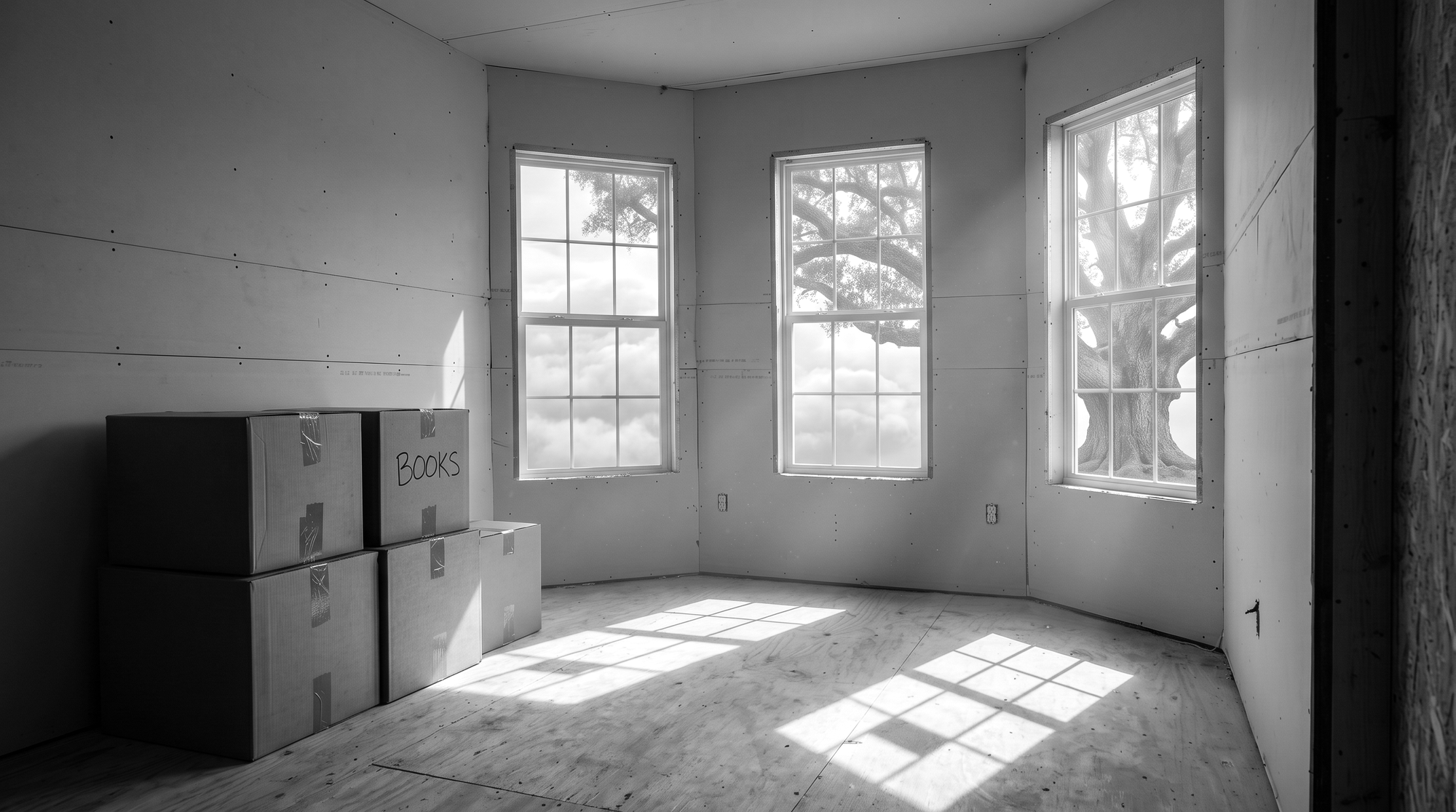
It will arrive in a week or so. And then, in all honesty, it will probably wait to join a couple of hundred other books sitting in moving boxes.
Because that's the real state of things. Back in November I wrote a sentence I didn't think twice about — "I bought more than a dozen books just in the past month" — and I only wrote it because I needed a scrap of text to feed into ElevenLabs, to hear whether a cloned voice sounded like mine. It did, which was unsettling in a way I'm still not over. It was also true. I had bought them.
What that sentence carefully didn't say is how many of them I'd read.
Then we moved to Florida, and the answer became: almost none. Not "fewer than I'd hoped." Almost none. A couple of hundred books came down from New Jersey, went into boxes, and have stayed there through a relocation, a build, a floor plan, forty furniture decisions and the small matter of winding down a career.
So when this turned up in my feed, I took it slightly personally.
The arithmetic, and the number it hides
I did some math before watching, because I wanted to see whether the video and I would agree.
A comfortable adult pace is 200 to 250 words a minute. Call it 250 if you're feeling generous about yourself. An hour a day is about 15,000 words. A normal non-fiction book runs around 70,000. So an hour a day finishes one every five days, which is seventy books a year.
Seventy is nonsense, and I say that as a man who badly wants it to be true. It ignores the skipped days, the falling asleep, the paragraph read three times because your mind wandered off to the electrical rough-in, the book abandoned at page forty that still cost you four days. The honest figure for a real person is twenty to twenty-five a year — less impressive, still enormous.
Twenty-five a year for twenty years is five hundred books, and nobody who has read five hundred books is the same person who started.
But there's a third number the video never mentions, and it's the only one I have actual data on.
Mine, this year, is close to five. Not because I stopped valuing it. Because I was busy 😦
Why reading is always the first thing to go
I've been turning this over, and I think I finally understand the mechanism.
Everything else on my list this year came with a deadline attached. The closing had a date. The movers had a date. The permit, the survey, the flooring selection, the preliminary walkthrough — every one arrived with a consequence for missing it.
Reading has no deadline. Nothing lapses. Nobody calls. It is the only thing on the list with no enforcement mechanism whatsoever, which makes it perfectly, permanently deferrable.
So it gets deferred. Not once — continuously and invisibly, for six months, by a man who would have told you at any point during those six months that he was an avid reader.
That's the finding, and I'd hand it to anyone in the middle of a big year. You don't lose a reading habit by deciding to. You lose it to six months in which something else was legitimately more urgent every single day. Each of those decisions was defensible. The sum of them was not.
So we're building it a room
Here is what I'm actually doing about it, and it's the least clever solution available.
The front room of the new house has a bay window. It was going to be a study/office, in that vague way that front rooms are always going to be office rooms. It's becoming the library instead — shelves, the boxes emptied, and a chair in the bay to catch the morning.
I retire at the end of this month. I intend to spend a good part of what follows reading books, and collecting more of them, which is a slightly unfashionable ambition in 2026 and I find I don't care.
I had assumed this meant building something — fitted shelves, floor to ceiling, the whole wall done properly. Then I counted what we already own. Two bookcases three feet wide and seven feet tall, one more at a foot and a half, and a short sculptural stand that takes sixty. That comes to about forty linear feet of shelf, which at eight to ten books a foot holds somewhere between three and five hundred.
Against a collection of two hundred.
So there is nothing to build. At twenty-five books a year, the shelves already in my possession will absorb about a decade of retirement before the question of a fourth one comes up.
The room doesn't need carpentry. It needs the boxes / books opened.
Which is worth saying plainly, because I'd got it backwards for a while. A couple of hundred boxed books are not a hope about the man I might become after retirement — they're evidence about the man who spent thirty years buying them. That life is already proved. It just hasn't had anywhere to sit down — and as it turns out, it has had, the whole time. I already owned the answer. I just hadn't counted it.
Which brings me back to Designology, a book about how rooms shape the people in them, bought this week, for a room being built to hold books. I'll let that one stand where it is.
Seven dollars and thirty-one cents, by the way. The room it's going to sit in came in somewhat higher.
A few things I'm setting up alongside the shelves, none of them clever either:
- Join the public library. I did, and it's the best thing I've done since moving here. It also solves the abandonment problem — walking away from a free book costs you nothing but the walk.
- Two on the go, one of each kind. One that improves you, one that just delights you. The improving one is a duty, and duties get skipped. The delightful one gets you to sixty minutes.
- Don't count. The moment the count is the point, you start choosing shorter books, and shorter is not the same as better.
- Give it a slot, because it will never earn one. The whole problem is that it has no deadline. So it needs an appointment, or the urgent eats it forever.
Thursday, Aug 20th.
The one book that reached me this year didn't come out of a box. I wrote in December that I was waiting to see a movie.
The Magic Faraway Tree is in cinemas — the Ben Gregor film, written by Simon Farnaby, with Andrew Garfield and Claire Foy as the parents and a cast including Nicola Coughlan, Jennifer Saunders and Rebecca Ferguson. It opened in Britain back in March and reaches the US on Friday the 21st, which means the Thursday preview lands on the 20th, at a cinema twenty minutes down the road in Davenport.
I read that book as a 6-7 year old. I read it because there was a tree with a different world revolving through the top of it, and you climbed up and might land in the Land of Take-What-You-Want, and if you dawdled the whole land moved on and left you there.
And here's the part I only noticed when I read the synopsis. The film is about a family who relocate from the city to somewhere unfamiliar, and it is the children, unpacking into a strange new place, who find the tree.
I have spent this entire year relocating to somewhere unfamiliar and have not once looked up.
Two hundred books in boxes, a room with bay windows waiting for them, and the one that got through this year got in when I was six or seven.