
Three-minute Studio Ghibli-style music video

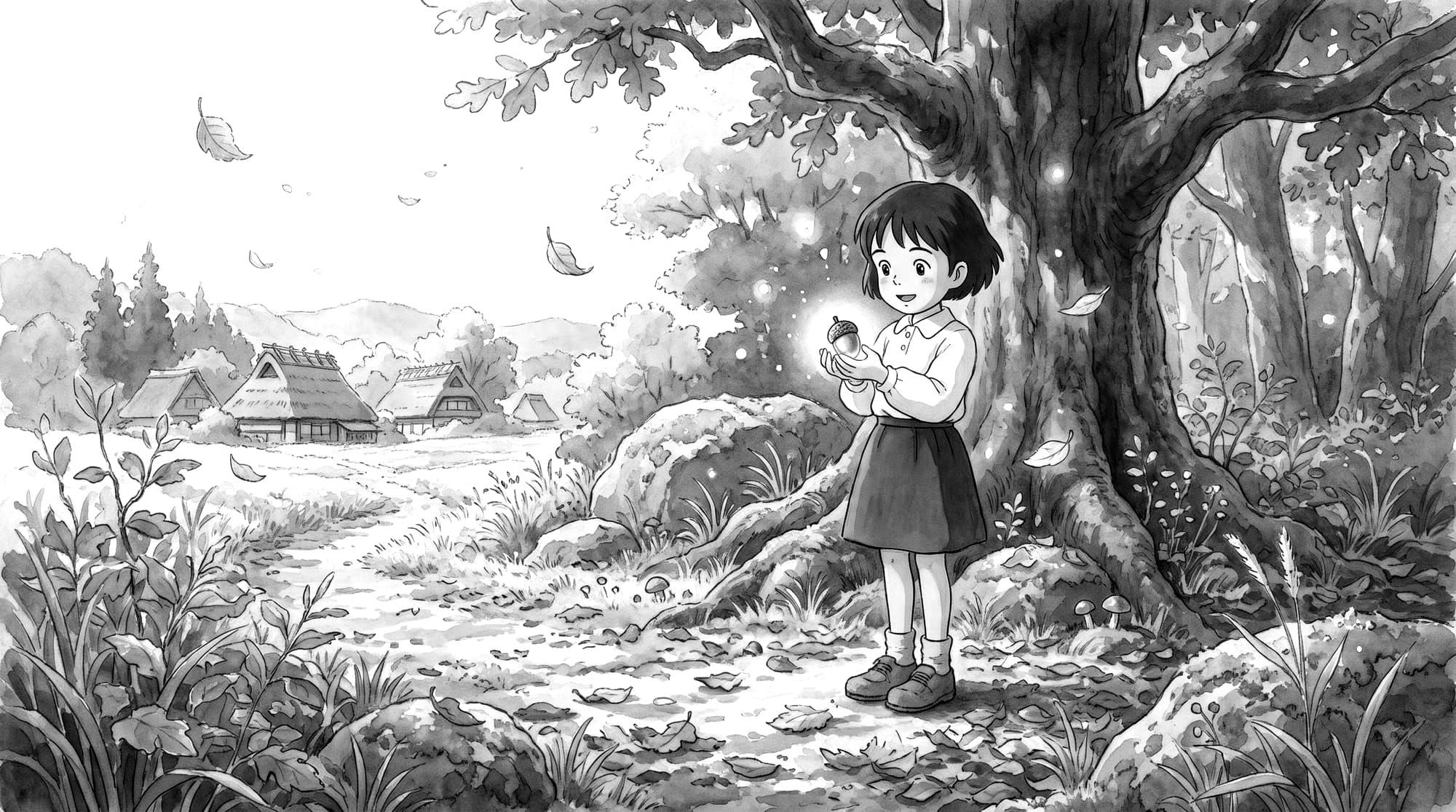
The short version (TL;DR): three-minute Studio Ghibli-style music video called "Acorns Are Made From" was made in a single morning - five hours, one person, a handful of AI tools and almost none of those five hours went where you would expect. This is how it was really done, told as a fable: an orchard keeper teaching four students that keeping one character the same across a whole film is a grafting problem, not a describing problem. If you have ever assumed the hard part of AI art is the art, this was written for you.
The music video
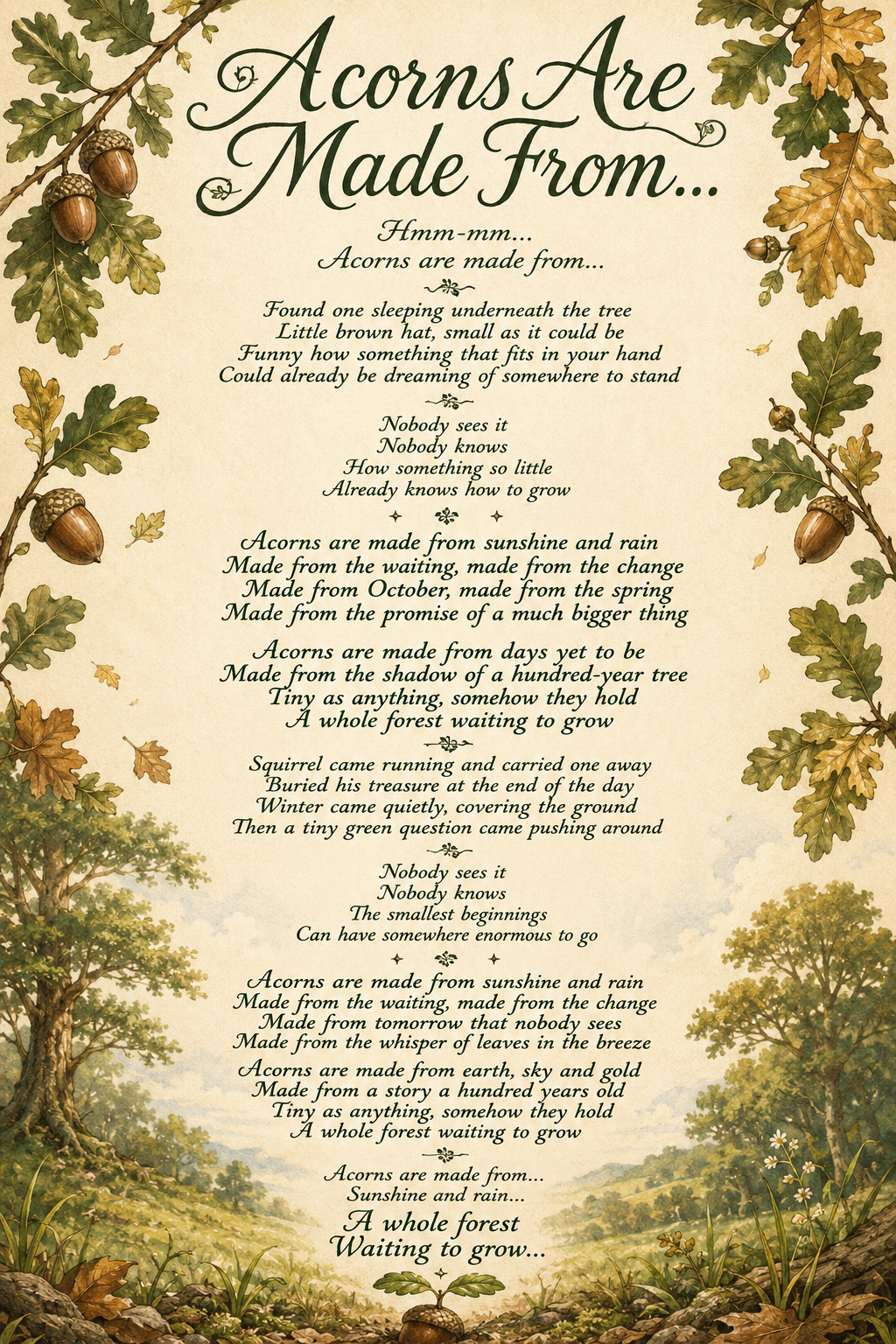
The Orchard Keeper Teaches Animation
It began, as these things often do, with a folder of forty-one girls.
They were all meant to be the same girl. Mags had asked for her forty-one times, in the same words, with the same careful sentence about the brick-red skirt — and had received back forty-one children who were, at best, cousins. Different noses. Different fringes. One of them was clearly about fourteen.
She brought the folder to the orchard because she had run out of anywhere else to bring it.
The class assembles
Vera's orchard ran in long rows down a slope. She had kept it forty years and was not a filmmaker; nobody had ever accused her of it.
Three others came. Tomas arrived with a notebook of two hundred and thirteen adjectives, alphabetised, which is the whole introduction he requires. Bo did not sit down. Ines carried one sheet of paper, folded twice.
"You grow apples," said Tomas.
"I do."
"We were told you'd teach us to make a music video."
Vera looked at the folder of forty-one girls. "I have spent forty years making a thousand trees agree on one apple," she said. "You want thirty-seven pictures to agree on one child. It is the same job."
Lesson One: The Graft
She started with the song, because the song is the only thing that cannot be argued with.
Three minutes and nine seconds, sung by a machine, about an acorn that becomes an oak. A second machine listened to it the way a tuner listens, and cut it into thirty-seven pieces that broke where the singer breathed. Seven minutes. The cheapest seven minutes in the craft, and they decide the shape of everything after.
"Now," said Vera. "Mags. How do I get a thousand trees to make the same apple?"
"Plant the same seed?"
"Plant the same seed and you get a thousand strangers." She put her hand flat on the nearest trunk. "Every apple tree in this row is a cutting off one parent tree. One. You don't describe the apple you want. You carry the parent with you."
They drew the girl once. Once, properly — one sheet showing her face from every angle, one painting of the clearing she would live in. Everything afterwards was grafted off those two pictures. The anchor: the parent tree you carry into every new row.
Mags asked whether that meant thirty-seven drawings.
"Thirty," said Vera. "Seven of them can grow straight off the branch before."
Lesson Two: Move the Ladder
Tomas wanted a close-up. He had eleven adjectives for it.
He tried all eleven. The machine gave him a face filling a third of the frame, then the same face filling a ninth of it, then a different child altogether — older, wrong mouth — because in reaching for the close-up it had let go of the parent.
"Read me the twelfth adjective," said Vera.
"I don't have a twelfth."
"Good." She carried the ladder eight feet along the row, set it down, and climbed three rungs. "There. That's your close-up. I didn't say anything to the tree."
Shot size is geometry. You do not get nearer by asking more beautifully. You get nearer by standing nearer. The ladder is the whole lesson, and it weighs nine kilos.
There was a second half, and it cost more. Both parent drawings had been made in autumn. The song crosses October, deep winter and full spring inside its own lyric — and every shot that did not name its month came back gold and russet, obediently, wrongly. The parent had been asked for a face, and had quietly supplied a season nobody ordered.
"An orchard is always the month you last looked at it," Vera said. "Say the month. Every time. Thirty-seven times."
The snow shot came back as snow.
Lesson Three: Twelve Times the Same Tree
The first full pass was, on paper, correct. Every shot matched. Every season was named.
It was also twelve near-identical pictures of one girl, centred, singing at the foot of one tree.
Bo wanted to fix it by rewriting the descriptions. He had pressed go nineteen times before breakfast and would happily press it nineteen more.
"Before you do," said Vera, "here is what things cost. A drawing takes forty-seven seconds to make again. A moving shot takes two minutes and three seconds. You are about to spend the expensive one to find out something the cheap one would have told you." She spread the whole batch out on the packing table, all of them at once, the way you lay out fruit before you decide what is going to market. "Look first. Always look first."
Then she made them write the boring list. Not adjectives — axes. How high the camera stands. Where the girl sits in the frame. What closes off the background behind her. Her posture, her shoulders, which side the light comes from, where her hands are. Seven things free to move while her face stays square to the lens — because the singing requires her face square to the lens, and requires nothing else at all.
Four shots low. Three high. Seven at eye level. No two backgrounds treated the same way.
That is coverage, and it is not a machine problem. It is the director's, and it always was.
Lesson Four: The List
Ines unfolded her sheet of paper. It held sixty-two things the picture must not contain.
One shot kept giving her two girls where there should be one. She had already forbidden it four different ways, in bold.
"Add a sixty-third," said Vera. "Or move the camera until the trunk fills the frame and there is nowhere for a second child to stand."
Ines moved the camera. There was one girl.
A branch does not stop growing into the path because you tell it not to. It stops because you gave it somewhere better to go. Say what you want in the frame and let it crowd out what you don't……a list of nots is just a list of suggestions, read aloud, in bold.
The showcase
The rendering began at half past ten, which is to say that two and a half hours of the morning had gone before a single frame of film existed. Bo found this unbearable, and was right to, and was wrong.
Forty-four moving shots, about two minutes apiece. Ninety minutes of a graphics card breathing hard in a spare room while four people sat in an orchard doing nothing, which is a fair description of most of filmmaking.
Mags's girl was the same girl in all thirty-seven. Tomas's close-up was a close-up. Bo, who had waited, had waited for something worth having.
And seven shots came back broken.
Ines took it hardest, because one was hers and she had done everything right — grafted, named the month, moved the camera instead of arguing with it. The machine handed it back with a mouth that did not match the words.
"Grade the decision," said Vera, "not the fruit. You made a good choice and got a bad apple. That happens on this hill about seven times in thirty-seven……and you know how much it costs? Two minutes. Do it again."
They did it again. At one o'clock there was a film: one hundred and eighty-nine seconds, four thousand five hundred and fifty-four frames, one girl, one clearing, one full turn of the year. Not one frame out of step with the song.
Five hours. Three hours and forty-nine minutes of that was the machine working. The rest was four people deciding things.
The six o'clock notices, read from the packing shed radio
Mags has drawn the girl a forty-second time. All forty-two are now the same girl. She reports that this is somehow worse.
Tomas has acquired a two hundred and fourteenth adjective. He has not used it.
Bo has pressed go. Once. He is still waiting.
Ines has thrown away the list of sixty-two things. She has kept one, and will not say which.
The orchard reports no change. It is October there, as usual.
From Vera's journal
Anyone can teach a machine to paint a girl under a tree. The difficult part……is teaching it to paint the same girl thirty-seven times, across a year that never happened, in a month it was never shown.
They all arrive believing the skill is in the asking. It is in the looking, and the looking is cheap, and nobody wants to do it because it feels like the part where nothing is happening.
So: the last thing you made that came out wrong — were you standing in the wrong place, or were you just describing it badly?
What it actually cost
The morning ran 08:00 to 13:00. Of those five hours, the computer was working for three hours and forty-nine minutes — 76% of the day — and the human decisions filled the gaps.
| Step | Time | What it was |
|---|---|---|
| Listening to the song | 7 min | Cutting 3:09 into 37 pieces that break where the singer breathes |
| Writing the picture briefs | 47 min | 50 descriptions for the still drawings |
| Drawing the stills | 49 min | 67 images generated, 30 kept — more than half the work was redoing |
| Writing the animation briefs | 21 min | 37 shot descriptions, ~34 seconds each |
| Checking the words against the audio | 15 min | 3 passes over the tricky regions |
| Animating | 90 min | 44 moving shots, ~2 minutes each |
Everything before "Animating" took two and a half hours — the film did not exist yet at 10:30. Roughly two of the five hours went on fixing failures and redoing takes, and that was the right trade: a still costs 47 seconds to redo, a moving shot costs 123.
Shipped: 188.9 seconds. 37 shots — 20 sung, 2 scene-setting, 15 cutaways. 4,554 frames. Seven shots redone after review. Zero drift between picture and song.
Tools, lightly: the song came from Suno; a listening model (Whisper) cut it into phrases; the still drawings came from Nano Banana Pro, grafted off one character sheet and one painted clearing; the movement and the lip-sync came from Minimax H3 running in ComfyUI on a graphics card at home. No studio, no crew, no render farm.
The characters and the orchard are fiction. Every number is real, taken from the build log of "Acorns Are Made From," 3 September 2026.