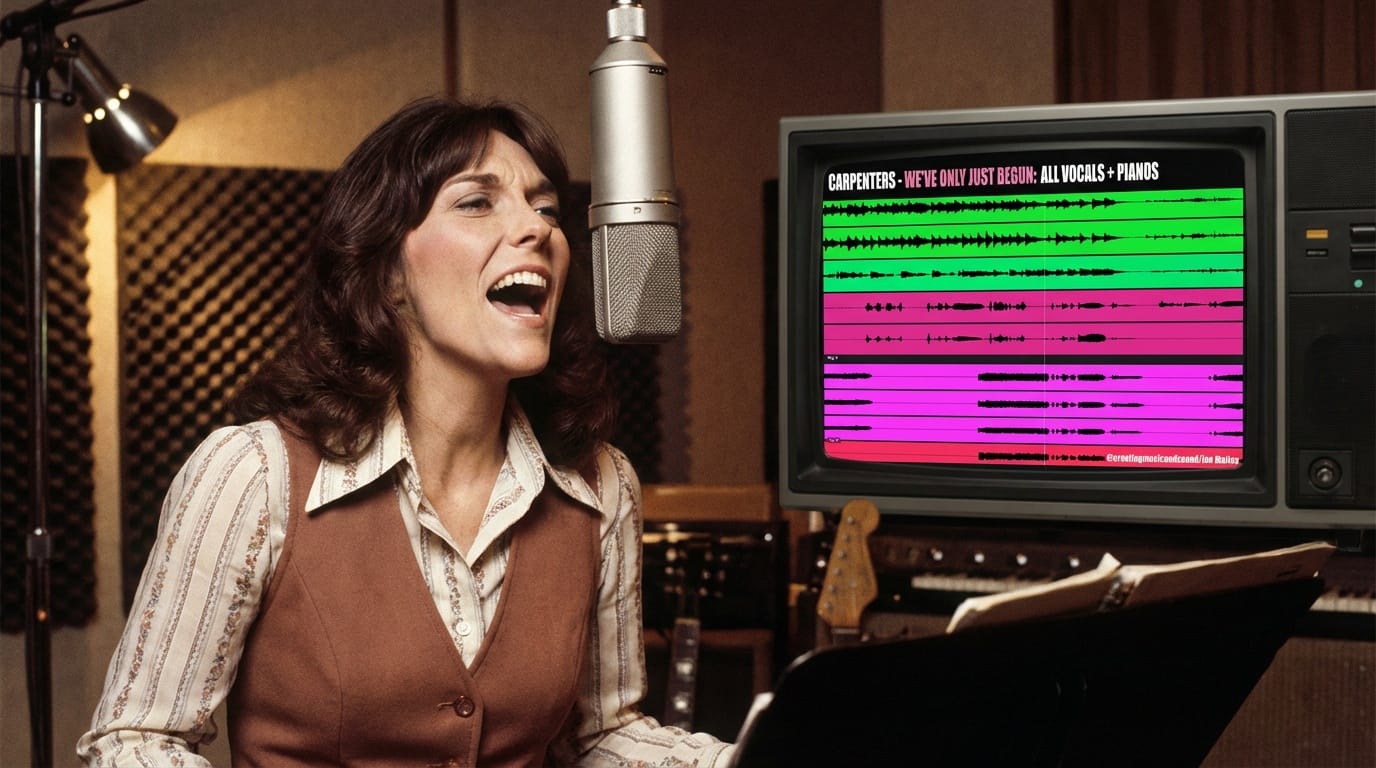
'We've Only Just Begun'
A video to give you a better appreciation of music.


Early one morning, while channel surfing on YouTube, I stumbled across this fantastic channel Creating music and sound that helps you truly appreciate music. Maybe it was because I was appreciating my new soundbar and subwoofer, but I sat transfixed by breakdowns of what went into the creation of songs.
The Secret Sauce of 'We've Only Just Begun': Lessons for Modern Creators
Creating Music and Sound is a YouTube channel that explains how music is built up.
In an era where a single click can generate a drum loop and AI can "fix" a vocal performance in seconds, we often forget the raw, tactile intentionality that used to define great art. Before the advent of endless digital tracks and automated mixing, music was an architecture of human choices.
The Carpenters' classic, "We've Only Just Begun," is a masterclass in this kind of "meticulous layering." When we pull back the curtain on its production, we find lessons that every modern creator—whether you’re a writer, designer, or entrepreneur—can use to make their work resonate deeper.
1. Build a Foundation with Punch
In the "olden days" of the studio, you couldn't just add infinite layers later; you had to get the foundation right. For this track, legendary drummer Hal Blaine recorded the kit with only two tracks—one for the entire set and one for the bass drum to ensure "punch".
The Lesson for Creators: Don't get lost in the "noise." Start with a core message or a primary goal that has enough "punch" to stand on its own. If your foundation is weak, no amount of digital polish will save it.
2. Embrace the "Bleed"
During the recording, Richard Carpenter’s piano and Joe Osborne’s bass were part of a live rhythm section. Because they were in the room together, the sound of the drums "bled" into the piano microphone. Rather than being a mistake, this created a natural cohesion. Richard even copied Joe's bass line in his final piano take because the synergy was that strong.
The Lesson for Creators: High-quality work doesn't have to be sterile. Sometimes, letting your different projects or ideas "bleed" into one another—showing the human connection behind the work—is what builds authenticity.
3. The Power of "Texture" and "Glue"
To make the song feel "lush and thick," the team didn't just turn up the volume. They panned the main piano hard left and an overdubbed Wurlitzer piano hard right. Then, they added a "glue" element: an uncredited tambourine player who made the groove feel solid and complemented the drums.
The Lesson for Creators: * Layer your insights: Just like the Wurlitzer, use different angles or "metaphors" to simplify abstract ideas and make them familiar to your audience.
- Find your "tambourine": Look for the small, symbolic details—the "parables"—that make your point more memorable.
4. Perfection Through Control
Karen Carpenter’s vocal performance is the stuff of legend. Her lead vocals in the chorus were doubled, but her control was so precise that the two tracks blended into what sounds like a single, unbreakable take. They then layered backing vocals multiple times to create a full, rich sound.
The Lesson for Creators: Excellence comes from the "shift of identity". Karen didn't just sing; she transformed the track through disciplined execution. For modern creators, this means going beyond the "hacks" and leaning fully into your craft to earn the trust of your audience.