
033 Newsletter, Aug 29, 2026


Everyone Arrived at the Same Corner This Week
I just published a post called Tenacity Makes Twenty. Curation Keeps One. It came out of a question from a creator in India who wanted to know how to get hired making images and video. My answer was that the making is no longer the job. Nigel gets one finished animation out of twenty image seeds and a dozen video variations. Hammel works at low resolution on purpose, so polish can't seduce him into keeping something mediocre. The scarce skill isn't production. It's discrimination - knowing which one to keep and having the nerve to bin all the others.
Then I found out well known author Daniel Pink had posted a video a week before mine, saying almost exactly the same thing.
His framing is sharper than mine: generation got cheap, judgment got priceless. He points at the volume — a hundred logos from one sentence, a song in seconds, three times as many books published as before ChatGPT — and argues that the only thing separating the good from the forgettable is a person with the taste to tell them apart. Taste, he says, is the one thing the machine can't do for you, and he lays out three rules for building it.
I didn't first see his video and agree. I got there on my own, from a different door, looking at a Discord full of people making pictures. When two people arrive independently at the same conclusion, it usually isn't a coincidence. It's the ground moving under both of them at once.
The assumption underneath the advice
Here's what took me a while to notice about my own post, and about Pink's.
"Cultivate your taste" is career advice, and career advice carries a hidden clause: that there will be a career, that AI is a tool you get to pick up and wield, and that the person with the better eye wins. It assumes the equalizer.
Bill Gates spent 6,000 words this week arguing that the assumption is a choice, not a given. His essay — The turbulent AI era is here. The choices we make now are critical — turns on one line: "AI will either be the greatest equalizer ever invented, or the worst source of injustice." Not both. Not somewhere in the middle. One or the other, decided by what we do now.
He names three risks.
- Jobs, because AI substitutes for human thinking rather than human muscle, and it's coming for law, medicine, software and manufacturing on a timeline measured in years rather than generations.
- Security, because the cyber and biological threats are arriving faster than anyone planned for.
- Control, because these systems may become genuinely hard to steer.
His prescriptions are as large as the problem: new national institutions, an international inspection body modeled on nuclear oversight, certain jobs reserved for humans by law, taxes on AI and robots. He also admits that the geopolitics make most of that unlikely.
What people actually think will happen
Data Expert Andy Cotgreave did a useful thing: he put Gates's binary conclusion on LinkedIn and let people vote.
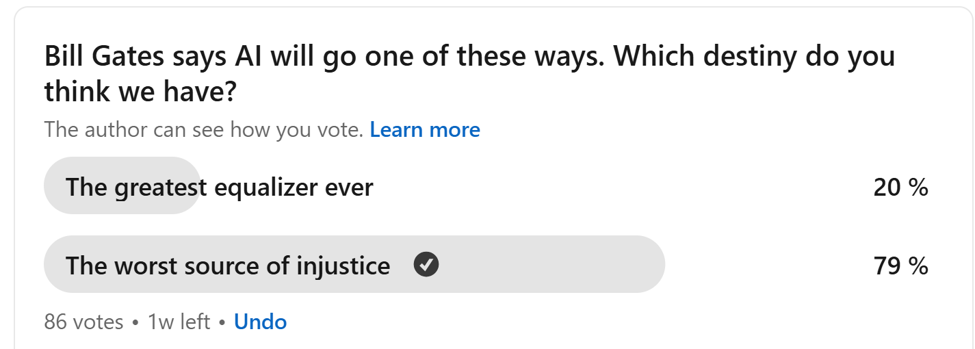
Eighty-six votes is a poll, not a study, and Cotgreave's audience skews toward people who look at data for a living. That's what makes it sting. Handed a genuine coin flip by one of technology's most credible optimists, a room full of analysts called it four to one against. I voted with the 79.
That could be dismissed as a mood in one corner of one network, except that Pew published numbers the week before Gates's essay saying it isn't. Fifty-two percent of Americans are now more concerned than excited about AI in daily life, up from 37% in 2021. Nine percent - nine - are more excited than concerned. Seventy-one percent expect AI to mean fewer jobs over the next twenty years, up from 64% in 2024. Five percent expect more.
And the fastest movement is at the young end. For the first time, a majority of adults under 30 are more concerned than excited: 55%, up thirteen points in a single year. Seventy-three percent of 18-to-29-year-olds expect the jobs to go. The generation that grew up with these tools in their hands has turned on them harder and quicker than anyone else.
The part I can't resolve
Pink and I both concluded that the answer is taste - that in a world of infinite output, the person who can judge is the person who gets paid.
Pew's most striking finding is that young adults, uniquely, say AI is hurting their creativity rather than helping it, and eroding their connection to other people.
The exact faculty we're prescribing is the one they report losing.
So the advice stands and the ground under it doesn't. Build visible judgment, because it's the part that's still scarce and still yours. That's true.
Seventy-nine percent already voted on which way they think this goes. I don't think they're wrong. I'm just not sure what to do about being right.
Sources
- Daniel Pink, Why Taste Matters More Than Skill (August 21, 2026)
- CNN, Bill Gates stakes reputation: AI is not like past tech (August 26, 2026)
- Andy Cotgreave, LinkedIn poll on Gates's binary (86 votes)
- Pew Research Center, Young adults in the U.S. are increasingly wary of AI, concerned it will take jobs (August 18, 2026)
- Sebastian Antony, Tenacity Makes Twenty. Curation Keeps One.