
Sebland Speaks No More

It started, as some of the best things this year have, with Nigel.
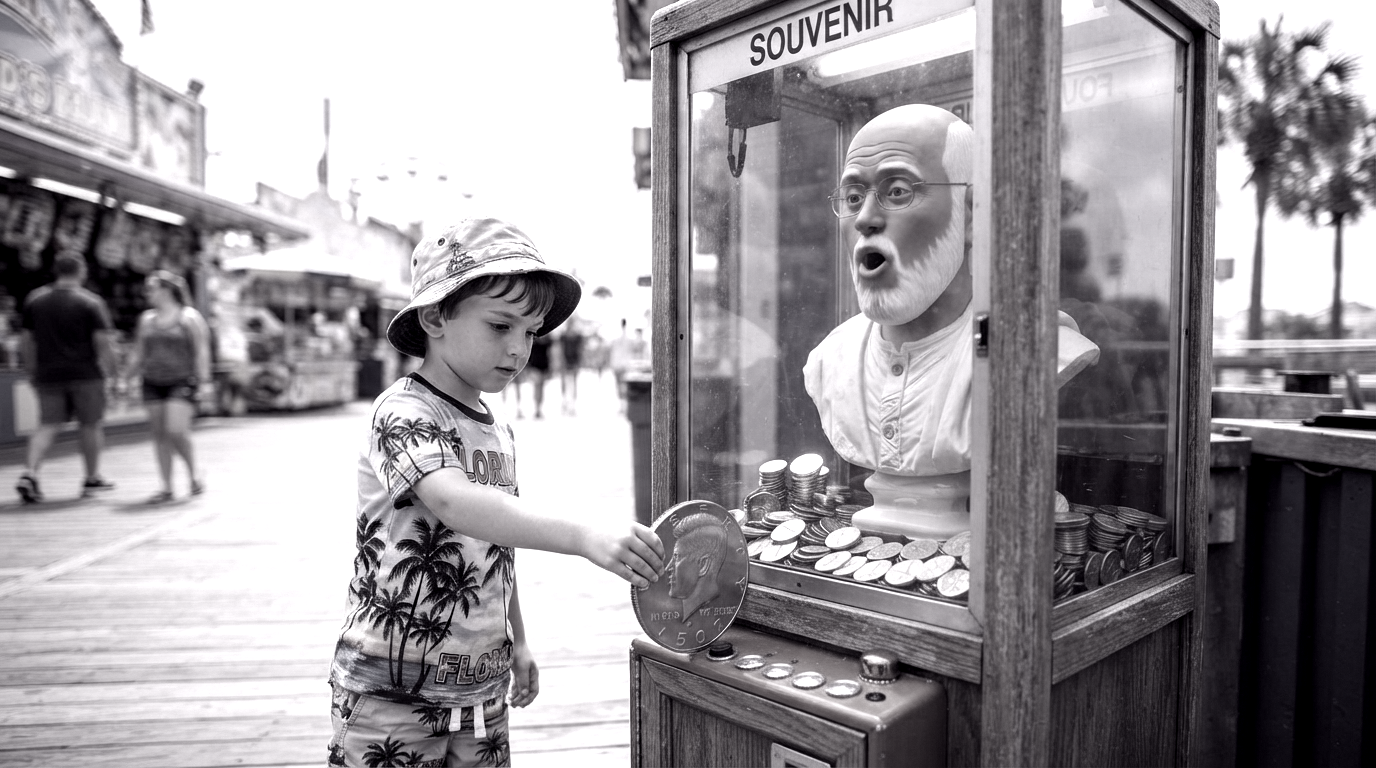
He sent me a video for one of the daily challenges — my own face, cast as a talking bust behind the glass of an old arcade fortune-telling machine, the orange cabinet, a little pile of gold coins heaped up at the base, a child reaching for the controls. I watched it three or four times. It was uncanny and it was funny and it was, frankly, a better likeness of my soul than most photographs. And then the thought that has cost me a great many afternoons this year arrived right on cue: what if it did something?
Because a fortune teller is a lovely thing to look at and a slightly silly thing to be. I don't believe a machine can see your future. But I am reading Adam Grant's Think Again, and there is a chapter in it that had been rattling around my head for weeks — about how you almost never change a person's mind by telling them things. You change it by asking. Grant writes about a technique called motivational interviewing, where a good interviewer doesn't argue, doesn't advise, barely offers an opinion at all. They ask open questions, they reflect your own words back to you, and somewhere in the middle of it you hear yourself say the thing you already believed.
And I thought: there's my fortune teller. A machine that has stopped telling fortunes — because in forty years behind the glass it worked out that every seeker who ever asked already knew the answer. It just hadn't heard itself say it out loud yet.
So I built it. In an afternoon. Vibe coding with Claude Fable — I described what I wanted, it wrote the thing, I described what was wrong, it fixed the thing, and we went round like that until a fortune teller existed that hadn't the day before. It even went through a small identity crisis on the way: it started life as "Zoltar," until I remembered that's a registered trademark and not worth a letter from a lawyer, became "Sebtar" for about ten minutes, and finally settled — with my face and my name in the cabinet — as Sebland. He no longer tells fortunes. He asks better questions.
sebland.sebastianantony.com
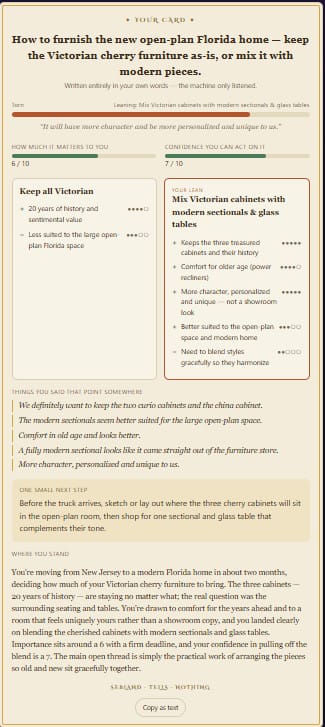
Here is how a session actually goes. You tell Sebland a decision you feel torn about. He asks you what's good about leaving things exactly as they are, and what pulls you toward changing them — both sides get a fair hearing, because being of two minds is normal, not a fault. He asks you, on a scale of nought to ten, how much it matters and how sure you are you could act on it — and then, cleverly, why a seven and not a five, which is the question that makes you explain yourself to yourself. And at the end, the machine whirs and deals you a card. Not a prophecy. A summary of everything you said — your reasons for and against, weighted by how much fire was behind each one, the phrases you used that pointed somewhere, and one small next step. It's your handwriting, essentially, read back to you in a nicer font.
I tested him, of course, on the most pressing decision in our house right now: whether to drag twenty years of furniture down to the new place in Florida, or start fresh. I sat there weighing five thousand dollars of shiny new furniture against a dining table and a china cabinet that have followed us since the beginning — and Sebland, who offered no opinion whatsoever, somehow walked me straight to the answer I'd been circling for weeks. Mostly new. Keep the pieces that carry the story. The china cabinet was never in any danger; I just needed the machine to make me admit it.
A few honest particulars, because I know a couple of you will ask:
What it costs. It runs on Anthropic's Claude API — real intelligence behind the glass, not a script — and a full session costs me about ten cents in credits. Cheaper than the arcade machine it's pretending to be. You pay nothing.
What it keeps. Nothing. Your conversation isn't saved on any server of mine; it's anonymous. The one thing you can keep is your card — there's a button to save it, and that copy is yours alone.
What it is. A fun experiment, first and last. It is not therapy, not advice, not a substitute for talking to a real person about a real problem. It's a mirror that happens to ask good questions.
If you'd like to understand the trick well enough to pull it on yourself — or on a stubborn friend — here's the shape of what Grant's book taught me:
Ask, don't tell. Advice makes people defend their position; a genuine question makes them examine it.
Reflect it back. Repeat someone's own words and they hear them properly for the first time.
Explore both sides. Give the "do nothing" option a fair trial — people trust a guide who isn't selling.
Find the change talk. Listen for the moment they argue for the thing themselves. That's the moment that counts. It has to be theirs.
Go and talk to him: sebland.sebastianantony.com. Bring a real decision — something you've been chewing on. Insert the coin. Let me know what he deals you, and whether the old fraud got it right.
He'll tell you nothing, of course. You already knew.