
The Slop Pile and the Struggle
Four videos I saw this week

The artist who walked away from their own channel
Picture someone who has spent ten years learning to build things in 3D. Six of those years in Blender, a free program that lets you make anything from a teacup to a whole city on a screen. If you have never tried it, here is what learning it is like: you drag tiny points around for an hour to get the curve of a handle right. You press "render" and wait, and the picture comes back pitch black because you forgot to switch on a light. You do it again. And again. One day the teacup finally looks like a teacup, and you feel ten feet tall.
This week I watched a video by a 3D artist who had run a teaching channel called BlendToPro. In it, the creator says plainly that they are burned out.
What wore them down wasn't the hard work. It was watching the hard work disappear. They describe the Blender corner of YouTube as filling up with what people now call "AI slop": quick, machine-made pictures and videos, produced by the thousand, with nobody really behind them.
The tutorials have changed too. Many no longer teach you how to model, light or animate. They teach you how to avoid learning to model, light or animate. The creator watched artists they admired step back, and big channels start promoting AI products that, in their view, cut out the learning altogether.
Then comes the part that stayed with me. They say:
"The struggle is the reward. The black renders, the wrong turns, the hour on one curve: that's the craft. Take it away and you haven't made art easier. You've removed the art."
So they did something unusual for a YouTuber. They walked away from the channel's old name and started a new, more personal one called Adel 3D, about storytelling and experiments, made "for the love of the process rather than the algorithm."
That could have been the end of a sad little story.
The handmade video that nobody's hands touched
The second video is a tutorial from a creator called AI Madame.
It shows how to make short educational videos in the style of stop-motion claymation. You know the look: little clay figures that move in tiny jerky steps, with thumbprints still in the clay. Traditionally it takes days of patient work to get a few seconds of film.
Here, no clay is involved.
For the novices among you, a quick translation. Claude is an AI assistant (the same family of tool I use in my own work), and a "skill" is a set of instructions you give it so it does one job the same way every time. This free skill, called Claymation Explainer, takes a topic and does the following:
- It writes five possible opening lines (the "hooks" meant to stop you scrolling), scores them, and tells you which two are most likely to go viral.
- It plans the video shot by shot.
- It writes the instructions for Google's AI picture and video tools to produce clay-looking characters and then animate them.
The example in the video is a volcano explainer, and it looks charming. The same method can also fake other handmade styles: real objects, crayon and pencil drawings, felt and paper.
Now compare that next to the Blender creator.
One person is giving up an audience because the handmade process is being squeezed out. Another is offering a free, step-by-step recipe for producing the look of handmade work with no hands at all. Even the thumbprints are generated.
I don't think AI Madame is a villain here. The tool is clever, and it's a genuinely useful way to turn out a teaching video quickly. That is exactly why it's unsettling. It's not slop. It's good. And if a machine can choose your opening line, plan your shots and fake your thumbprints, a fair question follows: what part of the work is still yours?
Meanwhile, the bill arrives
The third video took me somewhere I didn't expect: the stock market.
On Thursday, November 5, AI stocks fell hard.
Nvidia, the company whose chips power most of the world's AI (in effect, the shovel-maker in this gold rush), lost more than $400 billion in value in a single morning. That's more than most countries produce in a year, gone before lunch. The Nasdaq, America's tech-heavy stock index and roughly the US cousin of London's FTSE, fell into what traders call a "correction," a drop of about ten percent from its recent high.
According to the video, no single cause was to blame. Several pressures arrived at once:
- Voters pushed back. America had just held its midterm elections, the national vote halfway through a president's term. The results suggested that tighter rules on data centers may be coming, with towns in many places resisting new ones. Data centers are the huge, warehouse-sized buildings full of computers where AI actually runs.
- The power bill. Those buildings use enormous amounts of electricity. The video points to strained power grids and rising electricity costs for ordinary households.
- Chips stuck in transit. Reports said 600,000 Nvidia chips were stuck in Hong Kong because of trade complications.
- Year-end selling. Big investment funds sold winners to lock in their gains for the year, and there weren't enough buyers to soften the fall.
To be fair to the video, it does not claim the AI bubble has burst. Its conclusion is more measured: the market finally put a price on risks it had been ignoring.
Here's why this belongs in a story about clay figures and burned-out artists. We talk about AI as if it were weightless: you type a sentence and a video appears out of thin air. But the air isn't thin. Somewhere a warehouse hums with machines. Somewhere a grid strains, and a family's electricity bill rises. Somewhere chips sit on a dock. The "effortless" shortcut has an effort behind it. That effort has just been moved somewhere we don't have to look.
The Blender creator says the struggle got taken out of the art. The market says the struggle got moved onto the power lines. Neither is saying the struggle went away.
The professor who says: keep your hands on the wheel
So what do we do? Give up the tools? Pretend it's 2015?
The fourth video gave me the most useful answer. It's an interview between the host Marina Mogilko and Ethan Mollick, a professor at the Wharton School of business in Philadelphia and one of the most-quoted voices on how AI is changing work.
Mollick isn't against AI. If anything he's an enthusiast. He says it lets one person build and test ideas faster than ever. But he gave a name to the exact danger the other three videos were circling:
Cognitive surrender.
It's the moment you stop using the AI and start obeying it. It wrote the hook, so you post the hook. It chose the shots, so you shoot the shots. Each step is reasonable, and at the end you're a passenger in your own work.
To avoid that, he says you need four things:
- Deep knowledge: real expertise in your own subject.
- Wide knowledge: a working understanding of the fields next to it.
- Agency: you decide where AI belongs, not the other way round.
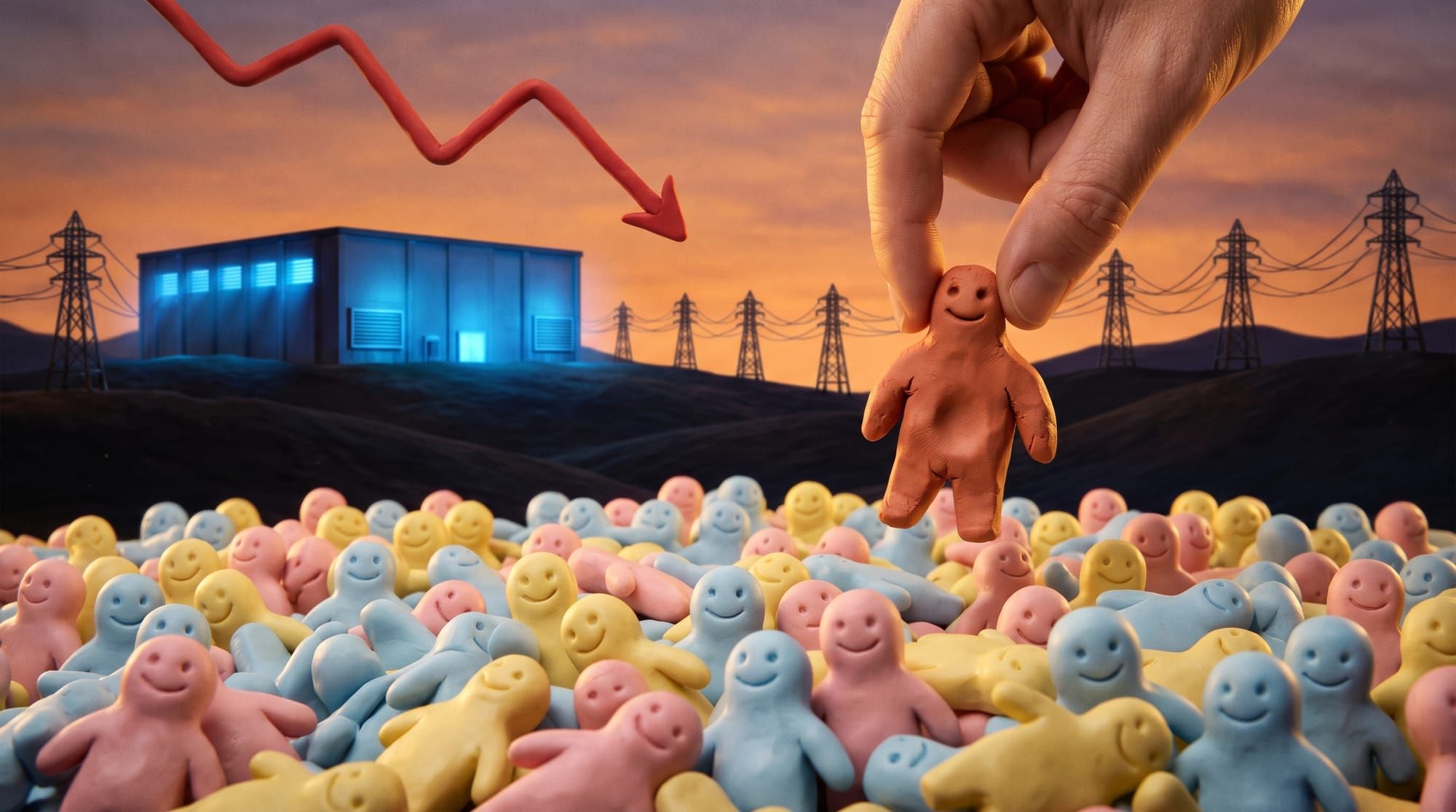
- Taste: the ability to look at a heap of machine-made options (he calls it the "slop pile") and know which one is actually good.
The fourth one stopped me, because taste is exactly what the Blender creator spent ten years building. Every black render taught them something about light. Every hour on a curve trained their eye. Taste isn't a setting you switch on. It's what is left in you after a thousand small failures.
Mollick names the danger here too. Junior workers used to learn their trade by doing the dull jobs for more experienced people, a kind of apprenticeship. Now, he says, many managers hand those tasks to AI instead. It's faster today.
But where will the next generation's judgment come from if no one is allowed to struggle at the bottom?
His practical advice is to treat AI like a team you manage, not an oracle you consult:
- Say clearly what you want.
- Check in often.
- Always ask for several options instead of accepting the first one.
- Write the first draft yourself whenever the thinking matters.
Let it fact-check and fill in forms. Keep the hard problems, the original ideas, the work only you can do, for yourself.
My own confession
Before I hand out any advice, I owe you a confession.
For the past week I've been using Claude Code to make short explainer animations.
My favorite style stars Mr. Spud, a little potato-headed character, and I really enjoy making him. I can turn out a short explainer video in about 1 to 2 hours.
By my own reckoning, I've surrendered. I never went through the long, painful process of learning animation. No black renders, no hour on one curve. I skipped straight to the finished film.
So I'm not writing this from the Blender artist's side of the fence. I'm writing from the middle of it: having fun, making things I couldn't otherwise make.
Where that leaves us
I wish I could wrap this up neatly. I can't, and I don't think I should.
Here's what I see, putting the four videos side by side. The shortcut is real, and it's getting better every month. The clay figures are adorable. The opening lines score well. And each time we take the shortcut, the struggle doesn't disappear. It moves. Sometimes it moves onto a power grid in a town that never voted for a data center. Sometimes it moves off the junior employee who never gets to learn. And sometimes, most quietly, it moves out of us, and takes with it the taste we would have built by doing the thing the slow way.
The Blender creator chose the slow way, out loud, at real cost to their channel. Mollick says you can use every tool going, provided you never hand over the steering wheel. Both are saying something uncomfortable: nobody is going to protect your struggle for you. The tools won't, the market won't, and the algorithm certainly won't.
So here is my small ask, from someone still working it out, for you, whether you build AI pipelines or have never typed a word into one.
Choose one thing this month to do the hard way, on purpose. Write the birthday card yourself. Sketch the garden before you photograph it. Work out the recipe without looking it up. Fix the thing before you search for the fix.
Not because the shortcut is evil. Because the struggle is the only place your taste can grow.
The slop pile isn't going anywhere. The question is whether we'll still know what's worth picking out of it.